
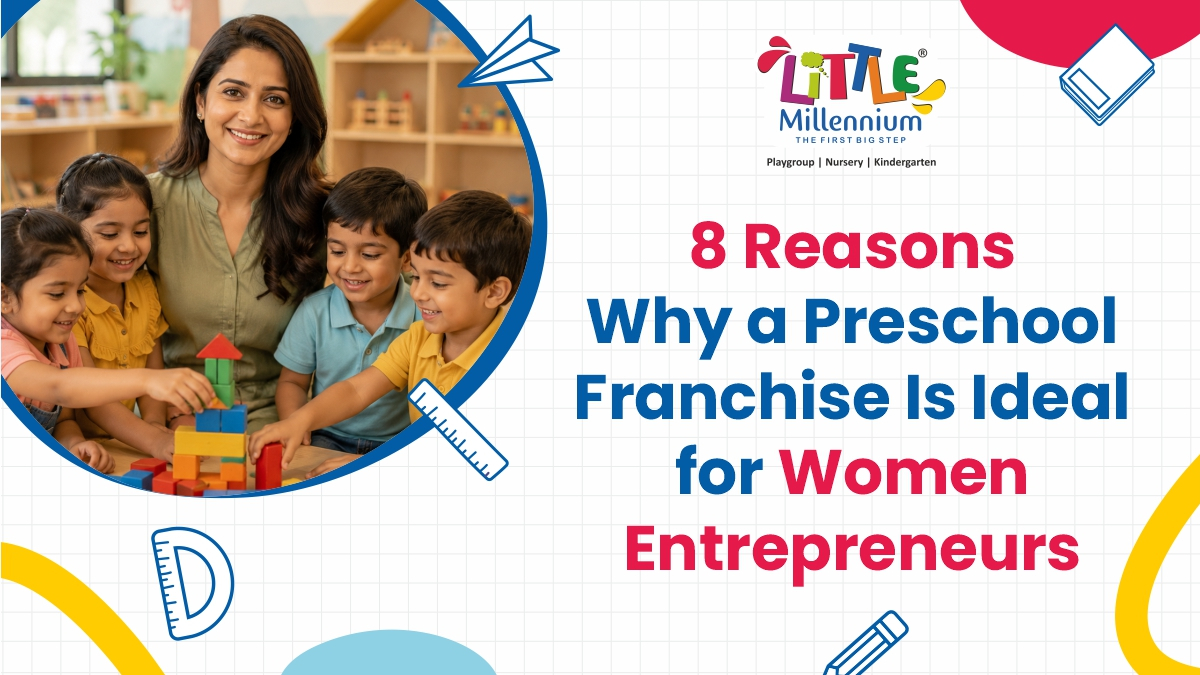
A preschool franchise addresses several of these structural barriers at once. Here are eight reasons why.
Reasons Women Should Invest in a Preschool Franchise
Reason 1: A Defined Investment and Real Ownership
One of the most consistent barriers women face in starting a business is access to capital. NITI Aayog research shows that only 4.3% of women-owned enterprises can access cash credit or overdraft facilities. That makes any home business for women who rely on unpredictable capital requirements a serious gamble.
With Little Millennium, that changes. Investment starts from Rs 15 lakh, home business for women seekers get brand access, curriculum, training, and centre setup in one fixed amount. No estimates and no moving targets.
Reason 2: : Flexible and Manageable Hours
Research consistently shows that time constraints, particularly the disproportionate burden of unpaid care work, are among the top barriers women face in sustaining a business. A business model whose hours are structurally incompatible with other responsibilities isn’t a business opportunity.
Unlike many business ideas for, a preschool runs on predictable school hours from mornings through early afternoons. Operations are scheduled, staffed, and seasonal, meaning an owner’s time commitment is manageable and foreseeable.
Reason 3: No Industry Background Required
A franchise for women model takes out the experience requirement. The franchisor supplies the curriculum, systems, and training while the owner manages the business, not the curriculum design. Little Millennium’s onboarding covers operations, curriculum delivery, and staff recruitment from day one.
Reason 4: Structural Support That Doesn’t Disappear After Sign-Up
Isolation is one of the most commonly cited reasons businesses fail in their first two years. Most new entrepreneurs don’t lack ambition; they lack a support system. An education franchise India model adds support into the contract. With Little Millennium, that covers centre setup, staff training, regional marketing, academic coaching, and compliance through the entire franchise term. New business owners aren’t left to figure it out alone.
Reason 5: A Sector That Rewards Communication and Community-Building
Parents choosing a preschool are making a decision that involves trust, information, and sustained relationship management, with both children and families. Those come from skills in communication, community-building, and creating an environment where people feel confident and welcome. These are capabilities drawn from a wide range of professional and personal backgrounds, including client-facing roles, team management, teaching, healthcare, community work, and more.
The best franchise for women in India is one where what you already know becomes a direct advantage, and that’s exactly what this sector offers.
Reason 6: Stable and Recurring Revenue
India’s preschool market was valued at USD 5.1 billion (Rs.48,281 Crores) in 2025 and is expected to reach USD 12 billion (Rs.113,004 crores) by 2034, growing at 9.16% annually. The growth is driven by NEP 2020, more dual-income households, and urbanisation.
For any low-investment business for women, income predictability matters. A preschool earns through steady enrolment cycles and monthly fees. Based on historical performance and industry benchmarks, most centres reach break-even within 12 to 24 months, with an anticipated ROI of 30–35% per annum, though actual results vary by location, enrolment, and management.
Reason 7: A Model That Can Grow With You
A part time business for women doesn’t have to stay that way. Many women start with one centre, run it well, then expand to a second or third once things are stable. Because the curriculum and systems are standardised, growth means applying what already works.
It also means the business can adapt over time. A centre that begins as a half-day preschool can evolve into a full-day model as demand from dual-income households grows. This flexibility is built into the franchise structure, not something each owner has to engineer individually.
Reason 8: Purpose and Profit in the Same Model
Early childhood education is one of the few business sectors where the financial case and the social case are aligned. Few sectors let you build something financially sound and genuinely useful at the same time. NEP 2020 brought preschool education into India’s formal policy framework for the first time, and private providers are now central to meeting that demand.
Little Millennium’s Seven Petal Curriculum covers seven developmental domains: cognitive, physical, social, emotional, language, creative, and values. Quality that’s built into the model.
Why Are Women Choosing Franchises and Why Education Leads
Structural barriers still limit women’s entrepreneurship in India. For example, 58% of women entrepreneurs aged 20–30 rely on self-financing due to limited access to collateral-backed credit. Traditional lending often excludes first-time women business owners.
The main obstacles are a lack of collateral, a thin credit history, and no established brand.. Franchising helps overcome these: investment is fixed, brands are known, and support is built in.
Education franchises stand out for women: the hours are flexible, demand is rising, and transferable skills like communication and trust are valued.
Government funding is reducing barriers: 68% of MUDRA loan recipients are women, and since 2022, over 1.26 lakh women have received business loans through Stand Up India. The 2025-26 Union Budget also promises term loans of Rs 2 crore each for five lakh first-time women, SC, and ST entrepreneurs. A preschool franchise is financially more viable to start than most women expect. MUDRA goes up to Rs 20 lakh, Stand Up India up to Rs 1 crore, the 2025–26 Budget scheme up to Rs 2 crore, and women are a named priority in all three. Little Millennium starts at Rs 10 lakh, which puts it squarely in the range.
Conclusion
For many women, the challenge is finding a business model that fits the realities of their lives while still offering meaningful growth. Preschool franchising sits at that intersection unusually well.
The investment is defined. The hours are structured. The support doesn’t disappear after sign-up. And the sector itself is growing, backed by policy, driven by genuine demand, and aligned with the direction India’s education priorities are moving. For women ready to move from considering entrepreneurship to building it, Little Millennium’s franchise model is built to make that step practical from day one.
Key Takeaways
Women-owned businesses now account for around 20–22% of India’s 63 million MSMEs, and women constitute 68% of all beneficiaries of the Pradhan Mantri MUDRA Yojana loan. This is a sure sign of a major structural change in how women are entering and financing business ownership.
A preschool franchise is one of the best businesses for women in India. It is an easy-to-start business model with low investment and strong support that helps new entrepreneurs get started easily.
Women-led businesses are on the rise in India. Women now account for 20.5% of all Udyam-registered MSMEs, contributing 18.73% of employment across the sector. Yet, numbers alone hide the real barriers: tough access to capital, uneven caregiving duties, and the risks or complexities of many business models that shut out first-time entrepreneurs. Finding business ideas that truly fit women’s realities is a challenge in itself.