
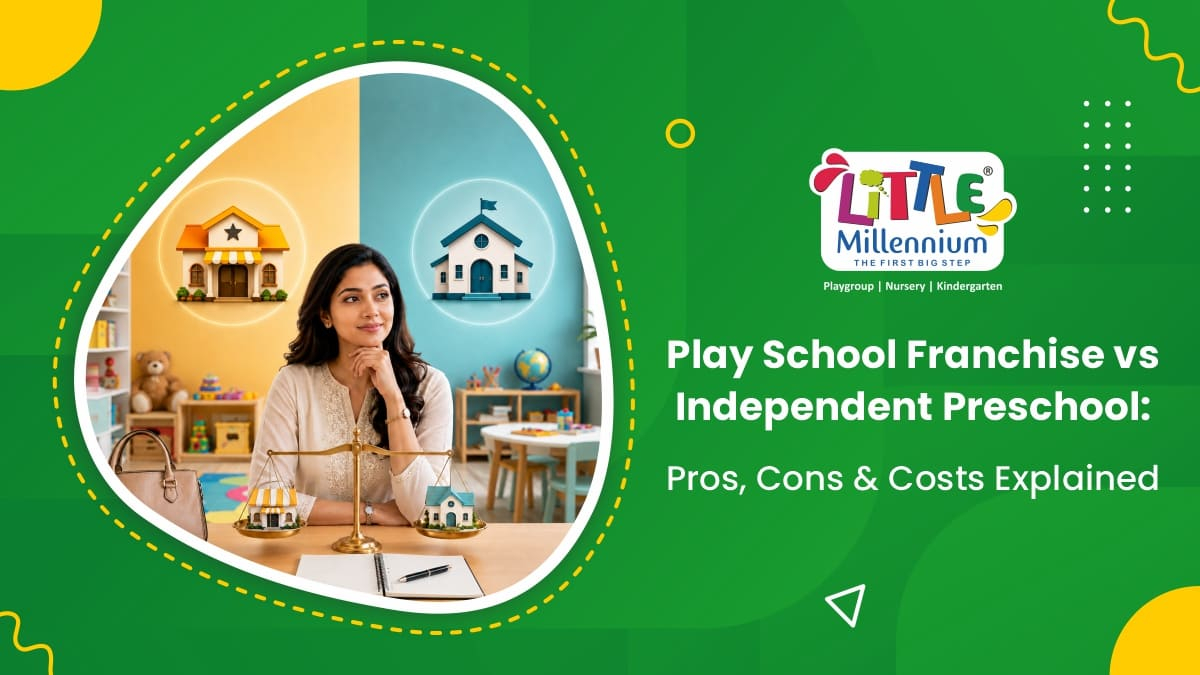
“Play school” and “preschool” get used interchangeably in India, but the name itself points at something real. Structured play, not worksheets, is supposed to be doing the actual teaching in both a preschool franchise and an independent preschool. The real decision isn’t which route offers “better” education in the abstract. It’s which one gets a first-time owner to genuine play-based teaching, and what that costs to reach.
What “Play School” Actually Means
India’s National Curriculum Framework for the Foundational Stage sets play-based learning as the standard pedagogical approach for the early years. Every centre is expected to deliver it regardless of business model; treating it as optional isn’t really on the table anymore. In practice, this means structured play, guided activities, storytelling, and hands-on materials do the actual teaching, rather than worksheets and early rote instruction pushed down from primary school methods.
This matters for the comparison ahead because it removes the assumption that “franchise” automatically means better teaching and “independent” automatically means worse. Both routes are expected to hit the same pedagogical bar. What differs is how much work it takes to get there, and how quickly a parent can trust that it’s actually happening.
Independent Preschool: Building Play-Based Teaching From Zero
Going the independent route means designing the curriculum, training the staff to deliver it, and proving to parents that both are real, all before the first admission season starts.
A structured, NCF-FS-aligned curriculum takes real expertise or a significant consulting investment to build correctly. Training teachers in the play-way method specifically, not just general childcare, usually means bringing in outside specialists or sending staff for external certification, both of which cost time and money that’s easy to underestimate until someone actually adds it up. None of this makes starting your own preschool a bad idea. It just means the curriculum and training costs that a franchise bundles into one figure show up separately, and often later than expected, for an independent owner.
Preschool Franchise: Buying a Working System
A preschool franchise compresses that entire buildout into something a franchisee can operate from day one. The curriculum already exists, already meets current standards, and comes with a training structure designed to get staff delivering it correctly without months of trial and error.
Little Millennium requires a minimum investment of ₹15 lakh. Training runs in two phases, an initial setup phase and curriculum-specific sessions once staff are in place. That structure exists because most incoming franchisees have never run a play-based classroom before and need more than a single onboarding session to get it right. The trade-off is real: a franchise fee and ongoing royalty cover the cost of not having to build any of this alone.
Comparing the Real Costs
| List | Independent Preschool | Preschool Franchise |
|---|---|---|
| Curriculum | Built from scratch, needs NCF-FS alignment work | Already built and standards-aligned |
| Teacher training | Outside specialists or external certification | Built into onboarding, two structured phases |
| Time to credible delivery | Longer, depends on how the curriculum work goes | Faster, system is operational from day one |
| Upfront cost visibility | Costs surface separately over time | Bundled into one transparent figure |
| Ongoing cost | No royalty | Royalty as part of the agreement |
Read side by side, the independent route isn’t automatically cheaper. It shifts the curriculum and training cost from an upfront, bundled figure to a slower, less predictable buildout.
Which Is More Profitable?
Neither route wins outright on profitability. A well-supported preschool franchise in the right catchment tends to reach stable enrolment faster, since parents recognise the curriculum and trust it sooner, which shortens the runway to break-even. Little Millennium’s own model targets an anticipated ROI of 30 to 35% per annum with a break-even window of 12 to 24 months, though actual results depend on location, market conditions, and how well a given centre is run.
An independent preschool that survives its slower early years keeps a larger share of each rupee going forward, since there’s no ongoing royalty. The faster path and the higher long-term margin aren’t the same thing, and which one matters more depends on how much runway a first-time owner actually has.
What to Look for in the Best Play School Franchise
Not every brand offering a preschool business opportunity has actually built its curriculum around current standards, whatever the marketing says. Before committing to any option, check for a named curriculum framework tied to NCF-FS, a disclosed teacher-to-student ratio, and a training structure with defined phases rather than a single onboarding call. Little Millennium runs a 10:1 ratio across a network of 900+ centres across 175+ cities, figures specific enough to verify rather than take on faith.
Conclusion: Choosing Between a Franchise and Going Independent
The play school vs independent preschool decision comes down to one honest question: how much of the curriculum-and-training buildout is a first-time owner equipped to do alone, and how much time does the runway allow? A preschool franchise buys a working system and a shorter runway to credible delivery. Starting your own preschool buys full control and, eventually, full margin, at the cost of building everything the franchise would have handed over.
Explore what a fully built play-based system looks like with Little Millennium: https://www.littlemillennium.com/franchise-with-us/
Key Takeaways:
- “Play school” in India specifically refers to a play-based, or play-way, method of teaching, and that pedagogical choice, more than the business structure itself, is usually what separates a strong preschool franchise from a strong independent preschool.
- Franchise brands typically arrive with a play-based curriculum already built and staff already trained to deliver it. Independent preschools have to build both from nothing, which is where much of the real cost difference between the two paths sits.
- Little Millennium’s own investment starts from ₹15 lakh, and that figure buys a working curriculum and training system rather than the raw materials to build one.
- Independent preschools aren’t locked out of good play-based teaching, but doing it well usually means hiring specialists or paying for outside training that most first-time owners don’t budget for upfront.
- Neither path is automatically more profitable. A franchise tends to reach stable enrolment faster because parents recognise the curriculum sooner, while an independent preschool that survives its early years keeps more margin once it’s established.
- The best play school franchise options are the ones whose play-based curriculum is genuinely built around current national standards, not just described that way in a sales deck.
Frequently Asked Questions
It depends on what the owner already has. Teaching or curriculum-design experience makes independent viable. Coming in without that background, a franchise’s already-built, already-trained system usually gets a first-time owner to credible play-based teaching faster than building it alone would.
A curriculum that already meets current national standards, staff training built into onboarding rather than sourced separately, brand recognition that shortens the trust-building period with parents, and a support system that’s been tested across many centres rather than built from a single attempt.
Neither is inherently more profitable. A franchise typically reaches break-even faster because of curriculum recognition and support; an independent preschool that gets through its early years keeps more margin afterwards since there’s no royalty. The right answer depends on how much time and capital an owner has for the slower path.
An approach that uses structured play, guided activities, and hands-on materials as the primary way young children learn, rather than worksheets or early rote instruction. It’s the pedagogical standard recommended under India’s National Curriculum Framework for the Foundational Stage.
Not formally, but delivering play-based teaching correctly usually requires either a background in early childhood education or investment in outside training and curriculum design help. Skipping this step is one of the more common reasons an independent preschool’s day-to-day teaching doesn’t match its marketing.
At Little Millennium, we make the early years count through a scientifically designed, developmentally appropriate, play-based curriculum that nurtures each child’s uniqueness and builds a strong foundation, academically, socially, and emotionally preparing them for future learning and success.