
Keep Your Child Engaged, Not Entertained

The month of October ushers in a lot of festivities, celebrations and fun times. Families plan get together, outings and the weather Gods shine benevolently, giving the much needed relief from a long period of summer.

For parents, it also means ‘holiday time’ for the kids. Schools are closed for a number of occasions and festival celebrations, which in turn means that children spend a lot of time at home. And keeping children engaged at home is quite a task by itself. And this is the time when the parent takes on the dual role of a teacher alongside being mom and dad.
No worries! Being at home can be fun and rewarding, both for you and your child. Listed below are some chores and tasks that you could safely engage your kids in. Studies show that children who are involved in household chores from an early age tend to me more responsible, accountable and achieve a greater degree of success even in their professional life at a later stage.

Initiate them into these tasks in a fun way and you could soon have them asking for more.

How to keep your 2 year old child engaged?
• While you are busy in the kitchen, give your child a bowl full of different sized pulses and beans to begin sorting. The little one will spend time diligently sorting out ‘dal, rajma and chana’. Make it rewarding by cooking the same bowl of lentils which the child sorted hours before. Seeing their own effort bearing fruit makes the child feel really worthwhile.
• Two year olds can also be given a ball of flour dough, to roll around, make shapes and knead to their heart’s content. Present their ‘artwork ‘at the dining table before the family for positive encouragement. Incidentally, this is one of the finest activities for fine motor skill development.
• When you are busy completing an office task, draw a few patterns with the help of a chalk on the floor (zigzag, horizontal, vertical, circular etc.) and get your child excited by giving him/her a toy car to race on the patterns. Change the toy if the child gets bored zooming around with the cars. This is an excellent activity for eye hand coordination and wrist movement too.
• Stick a piece of crayon vertically to a toy car and spread a few newspaper sheets. Allow your toddler to go racing on the newspaper sheets. Both of you will soon see patterns emerge out of this colourful scribbling.
• If you need to make an uninterrupted phone call, bring out the laundry basket and ask your child to take out the laundry and place it in piles as per the primary colours he /she is familiar with (red, yellow, green , blue) . Give them a free area to spread the clothes in piles. The reward can be something as simple as allowing the child to assist you in putting the clothes into the washing machine. Being allowed to assist in an adult chore is a big achievement for any 2 year old.
• Pick up an old piece of flat sponge sheet in the house and punch a few holes in it (maybe in a zigzag or horizontal pattern). Give your child a piece of wool or shoe laces and ask him to thread through those holes and perhaps make a pattern. Positive encouragement after every attempt is a must.

How to keep your 3 year old child engaged?
• Attempt all the above chores and in addition, a few more!
• Encourage the young one to fold napkins, handkerchiefs, vests, kitchen towels etc. and place them neatly in a pile.
• If you do the ironing at home, ask your child to button all the shirts and pass them to you for ironing. Likewise, the same can be done for the clothes that are sent to laundry  for ironing.
• Give them a bucket and a mug to water the plants in the balcony or the garden. Make simple rules, such as – half a mug for each pot. You may have to mop the mess for a few days but you will notice a marked improvement in their eye hand coordination with each attempt.
• Sit down with them and start making a grocery list. After your list is made, ask your pre-schooler to circle all the A’s, B’s, C’s and so on (all/any alphabets that he/she is familiar with). In short, you are encouraging language literacy.
• Get a pack of pipe cleaners and mould them in the shape of eye glasses, wrist bands, rings etc. they are very easy to make and soon you will find your children attempting to make the same with their fingers. Another excellent fine motor skill development activity!

How to keep your 4 or 5 year old child engaged?
• Attempt all the above and a lot more…
• By this age, the child should be an active participant in all household chores. Get them to lay the table, place the mats, plates, cutlery, napkin etc. in proper place. If you have two kids, rotate the duties for every meal.
• While you are busy in the kitchen, give your child some bread, butter and sliced cucumbers or tomatoes and let them know what non fire cooking is all about. Make their handcrafted sandwich look special by adding that special mother’s touch in the form of a smiley or a star on top of the sandwich. Munch together.
• With Deepawali around the corner, get your child a few packets of coloured sand (you can even make this at home) and allow them to practise making a few designs in the balcony or the driveway. To make things easier for you, let them do this activity before the cleaning woman comes in, so that the mess can be cleaned and your nerves remain unruffled.  Making a rangoli is excellent for strengthening the wrist and pincer grip of the child.
• With October ushering in the ‘Joy of giving ‘ week, live the values of compassion and charity by making a visit to the local orphanage / blind school/ old age home . Ensure that you and your child spend a couple of hours interacting with the inmates of these institutions. Remember, children are great imitators. They practise what they see.

Listed above are just a few activities. You can do a lot more.  Just get started and you will be surprised at the reservoir of ideas that will come rushing out.
Keeping children fruitfully engaged is a responsibility that every parent needs to pay close attention to.

Happy parenting!!!
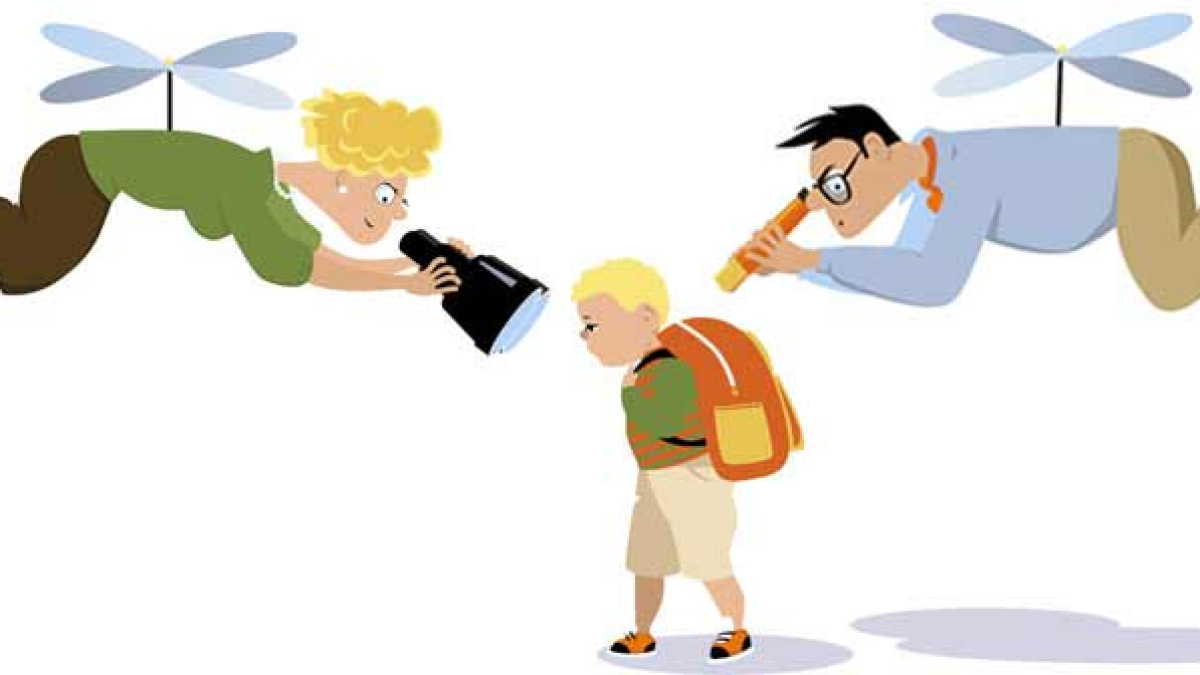
helicopter-parent

Helicopter Parenting

The dictionary states the meaning of the word helicopter as a machine /aircraft without wings, that has one or two large sets of blades that go round very fast on top.

And if you add the word parenting to the word helicopter, it means “constantly hovering over your child and taking decisions for them at a very rapid rate!”

In simple words, helicopter parents are parents who constantly hover over the heads of their children, making sure:

1. They don’t trip
2. They don’t rip their clothes
3. They don’t get their clothes dirty
4. They don’t climb the solitary guava tree in the neighbourhood
5. They don’t eat the occasional chocolate that fell on the floor
6. They don’t colour outside the lines
7. And always use a sanitizer before eating a snack!

Many would argue and say that this is exactly what an ideal parent should be.

Absolutely agree with that and let me clarify the difference between helicopter parenting and good/ alert/ responsible parenting.

Let’s just say that no matter how much attention you pay to your child’s hygiene, your child will catch some infection someday.

No matter how careful you are, your child will trip and graze his /her knees one day and no matter how particular you are, your child will probably try to wipe his/her wet hands on his/her clothes one day!

And that is absolutely fine. Your child needs to make mistakes, get messy and take chances. That does not make you a lesser parent. The lessons that your child will learn by falling off a bicycle or rolling in mud to fetch a ball that went off the boundary during a match, are real lessons.

By rushing in each time your child  stumbles, complains or falters, by not allowing  them  to mess around a bit, by not facilitating them to take their own decisions and accept responsibility for their actions, you are actually robbing them of the opportunity of learning essential life skills.

There is a very thin line between getting involved as a parent and being able to draw a line. It’s wonderful to be involved in your child’s life but it is equally important to let them take the occasional tumble and make their own decisions at times.

It is often out of concern or rather fear for the child’s safety that we, as parents, tend to “hover” around our children. No parent can be blamed for that as it is a dominant instinct amongst all parents. However, here are some questions that each parent could ask himself/herself before getting into the ‘helicopter mode and swinging into action’

1. Is my child in physical danger?
No parent wants to see their child run into danger. And by danger I mean crossing the road unaccompanied or walking unchaperoned on a busy street.  Falling down is “NOT” danger. If your child is facing an imminent physical threat, do get into action and after pulling them into the safety zone, counsel them of the imminent physical harm they could have got into. At the same time, if your child falls off a tricycle, do not lock the tricycle away in the garage. Children need to scrape a few knees and get a few bruises to learn how to steer clear of such trouble. They need to learn to draw their own lines at times.

2. Is your child posing a physical threat to others around?
If it is a normal scuffle between friends in the course of play, do not rush in to settle matters. Rather, pause and observe. Most such battles are borne away within seconds. But if you see the battle taking an ugly shape in the manner of fisticuffs, do hover in and instead of taking sides, encourage them to settle disputes by themselves.

3. If the play turns messy, if the paint splashes on clothes and mud splatters on shoes and socks and there is water spilt around – ask yourself, ‘is it causing any harm?’ If it is only leading to fun and camaraderie, giggles and happy laughter, join in the gang and be a kid all over again. Rein in the chopper pilot and believe me, the only thing it can lead to is some extra cleaning and laundry chore. But the feeling of happiness and joy will linger much after your laundry is done!

4. If your child skips a routine, colours outside the lines and wears shorts to bed instead of pyjamas – ask yourself, ‘does it matter and is it wrong ?’ If it really does not matter and it is not really wrong, it’s okay to relax and allow the child to colour the brinjal back and the sky green. That does not mean that you do not teach them that the brinjal is purple and the sky is generally blue. It means that you allow room for creativity and decision making. Let your child explain to you why they coloured the sky green. Allow room for their opinion instead of thrusting yours each time.

Life is all about falling and learning.

Be a responsible parent at all times but hovering around only leads to your child leaning back to you for decisions all the time. Each time they get into trouble, they will wait for you to bail them out.

Instead, teach them to gradually take their own decisions and accept responsibility for the same.

Foster Early Childhood Development By “Playing”

Play is the Best Form of Learning

“As astronauts and space travelers children puzzle over the future; as dinosaurs and princesses they unearth the past. As weather reporters and restaurant workers they make sense of reality; as monsters and gremlins they make sense of the unreal.”

Gretchen Owocki, An Early Childhood Educator and Author of “Literacy Through Play”

A little astronaut at play, pretending to travel through space in her spaceship, may look like mere child’s play to you, but these instances are much more than a child’s recreational and frivolous episodes. She is actually exploring, imagining, narrating and creating. And, she is accomplishing all this by following her most basic instinct – playing.

Most parents wonder, how’s that possible? What can children learn by just playing? How will they become successful in life if they spend their time jumping in puddles, creating stories and blowing bubbles?

Children are born learners. They have a natural curiosity to explore, discover and figure things out. Curiosity is the desire to learn, and play is the best way to inculcate this curiosity. They play because it is fun and adventure. Through the medium of play, they set simple tasks for themselves, decide on the success criteria, and at times, also establish a timeline for the challenge. With no apprehensions or fear of failure, they test and try until they succeed. Through play, children develop confidence and make sense of the world around them. When they’re completely and absolutely absorbed in their play, children develop important life skills without even realizing it.

Albert Einstein said, “Play is the highest form of research.”

Several studies by early childhood development experts and educators have shown that play is critical in early childhood as it lays a solid foundation for learning and is the medium through which children acquire a range of fundamental life skills which help them to be academically, socially and emotionally successful in years to come.

Core Strength Building – Early Childhood Development

When kids lift and throw the ball during a game of bowling, fly a paper plane or run around with a kite in their hand, they not only build strength in their core muscle groups, but also learn balancing and coordination. Similarly, Blowing bubbles helps them strengthen their speech muscles whereas squishing play dough and colouring with crayons, coordinates the small muscles in their hands and fingers, and prepares them for a major academic task – writing.

Thinking & Reasoning Skills – Early Childhood Development

Children learn to think, reason, and solve problems when they play. Playing with objects, in particular, allows them to observe, sort, compare and manipulate, leading to enhanced cognition. While constructive play with building blocks, puzzle pieces or board games helps develop logical reasoning skills, strategic and critical thinking; It also promotes knowledge of early math concepts like shapes and sizes, comparisons and contrasts, patters and symmetry. Building a castle with play sand or floating a paper boat in a bucket of water will spark interest in science as well as improve focus and concentration skills.

Learn New things – Early Childhood Development

Young learners also get an opportunity to develop language, speech, and vocabulary when they play. Whether they are roaring ‘vroom, vroom’ while playing with cars, identifying body parts while examining ‘patients’ with their doctor sets, or trying to identify different objects or creatures through a game, children observe, listen and pickup words during play. They learn new words and sounds, and also gain the ability to put them together and form sentences – a crucial requirement for success in school.

Inculcate Creativity – Early Childhood Development

Another extremely important skill that prepares children for school, as well as the life beyond it, is creativity. Play allows them to foster this key skill by encouraging new, original ideas, and gives them the liberty to question, experiment, and express themselves uniquely. Be it dancing and singing, doodling with paint and brush or tinkering with words, creative play helps children explore, persevere, and develop divergent and innovative thinking.

Nurture Imagination – Early Childhood Development

A key component of creativity, which cultivates social and emotional intelligence in children, is imagination. Whether they roar like a dinosaur while wearing T-Rex head gear, sing and chirp like birds with finger puppets or have an imaginary party with their friends, children learn cooperation, negotiation, sharing, and explore symbolic play through imaginative or pretend play. It is because of this imagination during childhood that, as adults, we are able to constantly visualize, solve problem, understand others’ perspectives, think creatively, innovate or invent new things. Children also develop self-confidence, self-awareness, self-control and self-expression through pretend play.

Play is essential for early learning, for it allows children to explore, experiment, and discover the mysteries of the world without restriction or fear. Spontaneous play is their way of mastering reality. As parents or child caretakers, it is our responsibility to ensure an environment that encourages play as a means to meet key developmental skills in young learners.

Summary

Play helps build healthy mind and bodies. Little Millennium Preschool associates high value to learning by playing. Our scientifically researched curriculum includes daily activities as part of the preschool curriculum in which kids learn by playing.

We at Little Millennium Preschool strongly believe, Play is not a break from learning, play is learning. It is the best form of learning for early childhood development

Screen-your-childs-screen-time

Screen Your Child’s Screen Time

Today, children are being born into a digital age where technological innovation has changed things faster than we can even imagine. First television, then personal computers and video gaming, and now smartphones and tablets, technology has permeated children’s lives like never before, and has done so at a young age.

If we go by recent studies, children as young as six months are being exposed to mobile devices, and by age one, at least one in seven children is using these devices for almost an hour a day. Also, children’s overall screen time has more than doubled since 1999, to over seven hours a day!

Digital devices, which are accessible at any time and from anywhere, are fast becoming a culture at home, school, college and work. In such a scenario, it is next to impossible to restrict children from engaging in various kinds of screens. Moreover, recent studies have shown that screen time can actually be beneficial in early childhood. Screens like iPads and smartphones can be used in ways that encourage cognitive, language and social development in children.

That said, it is also extremely important to assess the risks associated with children having too much screen time, because neuroscience research clearly establishes that young children need first-hand engagement for optimal growth. They need to play, manipulate objects physically, engage all their senses, imagine and fantasies, and interact with the 3-dimensional world.  Screens, which don’t involve a child’s whole body, brain, and senses, take time away from the activities that are critical for brain development and future learning.

During the first five years of life, the most essential neuronal connections are activated in the brain, and as children grow, everything they experience affects the quantity and quality of these connections. Passively sitting in front of a screen for hours and hours limits brain activity and inhibits the growth of these connections, and leads to slower cognitive development, delayed language acquisition, and long-term academic failure. Besides, when children are engaged with screens, the brain releases neurotransmitter dopamine, which encourages addictive behaviour and lowers attention span.

It also has a detrimental effect on children’s social and emotional well-being. By engaging with devices that do not reciprocate, children are failing to learn the ability to interact with others face-to-face, listen and respond appropriately to conversations as well as interpret human emotions. Moreover, children who are exposed to violent media on TV screens and in video games tend to exhibit aggression and often carry out similar aggressive imitations in their daily lives.

Experts believe that rather than feeling guilty about exposing children to screens and exercising total abstinence, parents should make educated and informed decisions about how to integrate technology into their lives without allowing it to take over completely. Even the American Academy of Pediatrics has softened its strict instruction of no screen time before the age of two and no more than two hours a day for older children. In its revised guidelines, the organisation says that while parents still need to set reasonable limits on the usage of screens, they must also pay attention to how their children are engaged with these screens.

Latest studies show that children learn more when their screen experience mirrors a live two-way communication. This means that active engagement and interaction with children during screen time can significantly enhance the educational value of the media they are watching. For example, when a child is passively watching television or a video on YouTube, there’s not much activity happening in the brain. However, when she is engaged in a video chat with a family member, a whole lot of brain cells are being activated, and contributing towards her cognitive and language development.

It’s equally important to keep an eye on what children are watching. Do your homework and try to curate high-quality, educative, non-violent and age appropriate content for your child. Use your judgment consult ratings reviews to collect media that is geared towards children and shows real characters in real situations. It is also vital to recognize when to turn the screens off. Create tech-free zones and media free times at home by ensuring there are no televisions, computers, video games, tablets or laptops on the dinner table or inside children’s bedrooms.

When children watch or interact with screens, they only see a representation of things in the real world. The pre-programmed virtual games with apps and computers require children to play according to someone else’s rules and design. On the contrary, real time play allows children to take initiative and make their own rules, experiment and ask questions, and create and solve their own problems. For this reason, it is essential to ensure that screen time does not take over your child’s play. Give your children ample opportunities to explore, experiment, and discover by replacing televisions, smart phones and gaming consoles with blocks, puzzles, board games and books.

While technology and screens will keep changing at a rapid rate, parenting will not. The same parenting rules apply to children’s real and virtual environments. By exercising the real life rules of setting limits and being involved in children’s lives, we can ensure that our little ones are exposed to technology in a way that helps rather than harms them.

References

http://www.greatschools.org/gk/articles/managing-your-childs-screen-time/

http://www.forbes.com/sites/jordanshapiro/2015/09/30/the-american-academy-of-pediatrics-just-changed-their-guidelines-on-kids-and-screen-time/#5d668523137c
http://www.scholastic.com/parents/resources/article/your-child-technology/set-limits-screen-time
http://edition.cnn.com/2015/10/06/health/screen-time-rules-change-pediatricians/http://time.com/3693883/parents-calm-down-about-infant-screen-time/
619a01d469e31ee0e2b18c013e33bb17.png

Infinite Ways Of Saying “I Love You” To Your Child

‘Do not worry if your child does not listen to you. Worry about the fact that he/she is always observing you. Your child will emulate what he/she observes rather than what he/she hears’.
That is perhaps the reason why all research around early childhood care urges the parents to ‘walk the talk’.
This blog on Parenting Tips, highlights the importance of making your child feel loved. It may not always be verbal but through your actions you can convey your love.

For eg. Children learn respect by watching the adults interact with each other.

Children learn to share by watching adults practise the same.
Children learn about courtesy by watching how their family members treat others.
Children also learn to love their teachers by hearing their parents talk respectfully about her.
In a gist, children internalise all experiences and draw conclusions.

The same holds true while saying the three magical words – I love you – to your children.
Children don’t just need to be spoken about love. They need to feel loved, they need to nurture love and they need to absorb the emotion in its most tangible form!

Being verbal is not just the only way to show love for your child.

Let us look at some day to day chores, activities and quality time tasks that you could engage in with your children – because they loudly scream I LOVE YOU!

1.  When you tickle them silly when reading a story
2.  When you attend their School sports day and cheer loudly
3.  When you cook  their favourite meal
4.  When you watch their favourite cartoon show along with them
5.  When you laugh sportingly at their jokes
6.  When you listen attentively to what they have to say about anything under the sun
7.  When you drop a sudden kiss on their forehead
8.  When you sit with them and help them do their homework
9.  When you wipe their tears after a sudden burst of emotion
10. When you help them choose the dress they want to wear
11. When you teach them how to pray
12. When you volunteer as parent helper for their  Annual Day at school
13. When you bake a cake for his/her best friend’s birthday
14. When Mummy helps Daddy in his chores and when Daddy helps Mummy in the kitchen perhaps
15. When you help them set goals for any task
16. When you take them for  a surprise picnic
17. When you encourage them to always speak the truth
18. When you devise a secret handshake with them – which only you two know about
19. When you reward them for a job well done
20. When you make them brush their teeth while patiently standing by the sink
21. When you leave  them a cute little love note in their tiffin
22. When you put down the phone and attend to them
23. When you keep up all promises made
24. When you speak fondly about their class teacher
25. When you get over your fears and perhaps get them a pet to play with!

The list is infinite because love itself is infinite and has no shape or boundaries.

Do not fret unnecessarily in case you do not say the magical words, I love you, often to your child.
Instead, work at making your love come alive through your actions.

Cleaning Up After Play

Playing comes as an inherent nature in a child. A child considers play his/her “work”, his/her devotion. And by that we mean serious work.
Time and again, child psychologists and early education experts have laid great emphasis on playing as the best form of learning.

Child’s creation, be it a picture, an attempt at painting,  building a sand castle   – whatever he has curated feels important to him. His/Her work has the same meaning and significance, as a power point presentation or an embroidered piece of cloth may mean to you. Perhaps even more significant because your child’s work (read play) represents newly-acquired skills and abilities. Maybe this was the first time he put the train tracks together himself, or maybe he finally figured out how to put the pieces of a dinosaur puzzle together.  

And just after he /she has reached the “Eureka “moment, comes in the parent declaring that it’s clean up time!

Asking the child to clean up immediately after he has managed a difficult task or acquired the roots of a certain new skill, is almost like asking a team leader to abandon the team just after it has started showing some profitability. Or like asking the captain of a ship to abandon the ship just after it has cleared the rough waters and is looking ahead for a smooth sail.

Stopping short or having to slam the breaks on creative play  is understandably going to be difficult at times for any toddler/child  — especially when  the main ambition raging within the child at that point of time is  – to feel in control – and you are usurping that need.
That said, playtime does eventually always have to come to an end — that is inevitable, but it’s also inevitable that our children may not always have to immediately clean up. Sometimes, we can actually allow them to leave their toys and creations, as it is.  It may contribute to an already overflowing playroom, it may literally and figuratively add to our feelings of drowning in toys and clutter and it may require that we have to go out of our way to walk around or over something treasured in our path, but when we do this, when we allow our child to preserve his/her “work,” we are sending a strong message of respect and appreciation for the time and effort he/she put into his/her project.
If you sense that your child may be reluctant to put his/her  toys or play material immediately away once playtime is over, acknowledge the importance of their work by telling him/her that they do not have to clean up pronto. Instead, make them feel that their creation is much valued, by saying:

• Let’s put your name on your creation so that everyone can appreciate it
• You don’t have to put this away, but we do have to move it. Let’s find a safe place to put it together.
• You can leave this out, but we have to take a break. You can come back to your work as soon as we are back home
• Let’s set it up where we can close the door, or where it won’t be in our way later
• You sure worked hard on this,  let’s take a picture of it before we put it away
• We need to put part of this away, but we can leave some of it out, you choose which part to keep out.
• Superb! This is such a special creation, let’s find a special place to hang/display it
• We are taking this as a gift for grandma next time we visit her. Until then, where do you want to keep it?

Being willing to consider their play as meaningful work actually models the kind of behaviour and skills that we would like our children to emulate.

Such as:
• Each effort is worthy of respect
• It’s okay if things don’t go our way, at times
• Be appreciative of everyone’s effort, time and creativity
• Sometimes it’s nice to let things just be!
• You don’t have to be in control all the time

And one of the biggest advantage of showing respect towards your child’s work of play ‘by just letting it be for a while, is that the child innately develops the ability to let go.  If you let the mess remain for a certain time, chances are that your child’s ability to move on improves drastically and in all likelihood, he /she will willingly let the project go. Gradually you will find the resistance to clearing the mess diminish.

So try. Try not to insist that your child has to clean up immediately after play all the time. It will mean so much to your child and show him that you really do respect his/her important ‘work’.

Let your child know that most of the time, it will be important to clean up but sometimes, you can bend the rules.

Just sometimes you can let the clutter reign and let his/her masterpiece steal the spotlight!

1af4360a5531ff6cf9f0145121806419.png

Inculcate Self-Esteem In Daughters

Self-esteem in simple words is an attitude towards self.  It can be explained as ‘having great respect towards your own self’.

Self-esteem means coming to terms with your complete self, just the way you are and embracing yourself in a most certain manner. For children, self-esteem translates to “emotion towards self”.

It is extremely important to cultivate self-esteem in children as it is self-motivating for them. They take better control and command of their lives. And most importantly, they develop an ability to surround themselves with people who support and encourage them.

It is true that irrespective of gender, boys and girls both need to be nurtured with a sense of self-esteem. But today in this article, Let us simply focus on cultivating self-esteem in our young daughters. A well thought of and deliberate approach will lead to better adjustments in later teen years and possibly give the world many shining stars to the likes of Aung San Suu Kyi, Saina Nehwal and Chanda Kochhar !

Parent’s Role: What you could do?

Build a strong foundation: – From her very first breath, remind your daughter on a daily basis, through words and action, that she is strong, smart and beautiful. Research confirms that girls with low self-esteem most commonly receive less praise and more criticism from either parent. Let her know that she was loved and treasured even before birth.

Part of A Bigger Picture: – Right from a young age, show your daughter that she is part of a bigger picture.  Tell her that she is an essential part of the bigger family. There are people in the family who love her, like her grandparents, aunties, cousins, friends, siblings. Let her feel the sweet feeling of being ‘cushioned’ by loving relatives and close friendships.  Tell her that her presence in the family as part of the bigger picture matters a lot.

A Role in Her Family: – Apart from knowing she is loved within her family, let your daughter know that she has an important role to play in it. She is a big/little sister, a cherished daughter, a niece, a granddaughter, and each relationship in her life is enriched by her being in it. The family would not be the same without her; she is valuable and special and needed. Let her know that! Be sure to encourage her role in family.

Focus on her uniqueness. : – Apart from regular school activities, help her to make time in her weekly/monthly schedule to focus on her hobbies. Let her know that her hobbies and passions are so important and that she should look for ways to work at them. Help her define what they are as she grows up.  Ask her leading questions about her interests and listen to what she tells you. Expose her to a wonderful variety of activities, hobbies and sports and see what she loves doing. . Perhaps she aspires to be a motivational speaker; a caring physiotherapist, a doctor, a professional athlete who inspires young children, a great writer. Help her to know herself, to develop her talents and to share them with the world.

Teach her to speak up: – Encourage her to find and use her voice. Teach her to use her voice as a muscle — the more she uses it, the stronger it will be.  Remember – Speaking on behalf of your daughter most or all of the time limits her self-worth.

Introduce her to active physical sports: – Do not underestimate the power of organized sports. The earlier you can get her hooked to sports and physical activity to keep her involved, the better it is. The opportunity to develop strong relationships with other girls and boys  while working toward a common goal and to develop confidence related to something she does rather than simply how she looks, talks and acts is essential to building and maintaining self-esteem. Studies also suggest a significant decrease in participation in risky sexual behaviour among girls who play sports.

Help her to know her own body /her own physical self: – Remember that knowledge is power. It is crucial that your daughter knows and understands her own body.  If she does so, she will be better equipped to deal with hormonal changes in her physical self later on in life and the impact that such changes have physically, emotionally and psychologically.  The golden rule to follow -she cannot value nor protect a body that is foreign to her!  If she cannot get open, honest and accurate information from her parents, she will get it from less-educated sources that may leave her misinformed and far less able to protect herself.

Limit her access to media early:-Media tends to build stereotypes.  A great deal of television and print media sets unrealistic physical standards and portray over-sexualized, disempowered girls and women. If it goes unchecked, it will shape your daughter’s sense of reality and the standard she is expected to meet for acceptance, desirability and success. Additionally, it is essential that you gradually help her to achieve media literacy so that even when she is engaged with it, it will be with a more discerning mind.   Let her see more of real men and women than digital ones!

Daddy – you are always being observed! : – All fathers need to be aware of the power of their words and actions. The way a father expresses his feelings and respect for women directly impacts the way his daughter sees herself and the degree of respect and overall value she will expect to receive from boys and men, later in life.

Mummy – you are a living role model:-Mothers should   never forget that they are the most important role model for their daughters. So if we obsess too much over physical appearance, appear low on confidence, and do not exhibit strong values – our daughters are likely to imbibe the same attitude.

Self-esteem is a fragile thing. Once broken, it’s difficult to piece together. But once cemented, it is difficult to rip apart.

Happy parenting!

a035a8275019dc94a2d59a3893c11866.png

Preparing 21st Century Children For A Global World

‘We cannot always build the future for our youth, but we can build our youth for the future.’
Franklin D. Roosevelt, Former US President

Today, a good academic education is no longer the only pathway to prepare children for the future. Young learners also need certain key skills to take advantage of the unique demands and opportunities that await them in the 21st Century. These critical skills which should be inculcated in a preschool child are:
• Critical Thinking and Problem Solving
• Creativity and Innovation
• Communication and Comprehension
• Collaboration

Our children are living in a world that is significantly different from yesterday. Newer technologies have risen and enhanced the way we live, work and collaborate. Rapid globalisation and technological revolution has brought about, and will continue to bring, changes quicker than ever before. It is intriguing to imagine the future and the fascinating change it will bring.

We might not be able to envisage the tomorrow, but we do know that our children will graduate into a world that will be radically different from today. Their academic, professional and personal lives will be full of innovative challenges and novel opportunities. By equipping them with the key 21st Century Skills, we will ensure that our children are adequately prepared to take on and address these challenges and opportunities, and be successful in this ever-changing and inter-connected environment.

In this century, knowing is not enough. The ability to use that knowledge, in different ways, to solve problems, is crucial to succeed in an increasingly competitive and global 21st century. Problem solving and critical thinking skills need to be fostered to help children, not just know facts, but have the capability to understand and analyse them, infer from them, connect and transfer them to other concepts, evaluate and manipulate them, put them together in new ways, and apply them to find solutions to new problems.

Critical thinking also leads to development of other skills, such as a high level of concentration, deeper analytical abilities, and metacognition, or the ability to think about one’s own thinking.

To be an effective critical thinker, one also needs to be creative and innovative. Successful problem solvers create many original and unusual possibilities to solve problems. Author and business thinker, Daniel H. Pink, in his book A Whole New Mind, claims that we are moving from a logical and linear Information Age to an inventive and empathic Conceptual Age. People with right brain thinking capabilities, like artists, inventors, designers, storytellers and big picture thinkers, will rule this century. Right brain characteristics, like creativity and inventiveness, will equip our future generations to look critically towards the big picture and come up with unconventional ideas and solutions.

Communicating effectively and clearly has always been one of the key factors for success. However, advances in communication technology in the 21st century demand exceptionally refined communication skills. Children must be able to communicate with speech and text through multiple communication mediums. Good communication skills are needed to not just express thoughts and ideas, articulate opinions, and communicate coherent instructions, but also to listen effectively to decipher meaning and intention in an increasingly inter-connected and multi-lingual environment. Strong communication and comprehension skills are also becoming increasingly important to analyse, process and effectively use or leverage the tremendous inflow of new information in this fast evolving world.

Collaboration is another key skill that children need to imbibe, in this complex and increasingly shrinking world. Sharing responsibility for collaborative work, willingness to help and make compromises towards a common goal, value individual contributions in a team, effectively and respectfully work with culturally diverse teams, is needed to meet the 21st century demands and flourish in an inter-connected world.

Parents, today, need to focus on building these critical 21st Century Skills from early childhood, as a child’s brain is twice as active, as that of an adult’s, during the first six years of their life. In these formative years, they actively seek knowledge. Their natural inquisitiveness and spontaneity to learn must be nurtured, as it will lay the foundation for all their future learning. The right learning experiences during these years will have a great impact on development of their future intelligence.

Inculcating 21st Century Skills with life or career skills like flexibility and adaptability; responsibility and accountability; initiative and efficiency, inter and intra-personal skills, is what is needed to help us raise competent global citizens for a global world.

Children who will have the knowledge and skills to be unfazed by constant change and reinvent themselves for new jobs, situations and lifestyles, will succeed in this continuously changing century.

525cc3ab11b971d8ec1dc7ed242a543f.png

The Left Handed Children In A Right Handed World

We live in a right-handed society. Our civilization has been built around a tradition that regards the right hand as preferable to the left. Hand tools, machines, even doors were designed on the basis of this attitude. However, several years ago, Dr. Frank Freeman observed:

“The number of left-handed children seems to have increased in recent years. This may be due to relaxed home and school discipline as well as the recommendations of medical authorities that children who show early preference for the left hand should not be changed. Whatever the reason, these children are entitled to just as much guidance and help in the development of the skill of handwriting as the right-hander receives.”

Recent studies indicate that the number of left-handed children is still on the increase. Estimates range as high as ten to 15 per cent of the population. Almost assuredly, the elementary teacher will be teaching handwriting not only to right-handed children, but will also have the responsibility of instructing the left-handers. The role of parents too is extremely valuable here as important support.

Determining Hand Dominance

How can one decide which hand the child should use in writing? Wrong choices at the readiness and pre-primary level could be detrimental to the child’s writing and perhaps to the child’s learning ability and personality. The choice, then, is an important one.

If the child is definitely left-handed, it is better to teach her or him to use that hand in writing. If, however, there is some doubt as to which is the dominant hand, there are several simple ways of determining which will be the hand to train.

A few guidelines should be observed in these procedures. Do not tell the child that she or he is being tested.  Keep a record as to which hand is used for each specific situation. Let the child pick up the testing materials; do not hand them to the child. Keep a tally of the procedures. If the child indicates true ambidexterity, it is probably better to train the right hand.

Several procedures are listed below. Create simple play situations with these procedures that will help the observant teacher or parent for determining hand dominance.

Hand puppet

Place a hand puppet on the table. In a play situation, observe the child to see which hand she or he puts the puppet on.

Key and lock

Padlock a cupboard in the child’s room / classroom. Place the key on a desk. Ask the child to take the key and unlock the padlock and bring you an object from the cupboard. Observe the child as she or he unlocks the padlock and picks up the object.

Hammering  

Place a toy hammer and toy nails, or pegs and pegboard on the table. Observe the child as she or he hammers several nails into place, or puts pegs into pegboard.

Screwing lids on jars

Place several jars of various sizes with removable lids on the table. Place the lids in a separate pile. Ask the child to match the lids with the jars, put the lids on the jars, and close them.

Throwing a ball

Place a rubber ball on the floor. Ask the child to pick up the ball and throw it to you.

Holding a spoon

At lunchtime or in a play situation where the child must use eating utensils, observe which hand is used.

Cutting with scissors

Place a pair of safety scissors and a piece of coloured construction paper on the table. Instruct the child to cut the paper into strips. Observe which hand is used to pick up the scissors and to cut the paper. Next, place paper of a different colour on the table and have the child repeat the process. Did the child use the same hand or change hands? Repeat with a third colour.

Positions for Writing

Paper Position

For manuscript writing, the left-handed children should position the paper with the lower right corner a little to the left of the midsection. For cursive writing, the paper is slanted less, with the lower right corner pointing toward the midsection or just a little to the right of it. The strokes are pulled down toward the left elbow, whether manuscript or cursive is being written.

Pencil Position

The writing instrument is held between the thumb and first two fingers, about an inch above its point. The first finger rests on the top of the pencil or pen. The end of the bent thumb is placed against the writing instrument to hold it high in the hand and near the large knuckle. The top of the instrument points in the direction of the left elbow. The writing should take place within the left half of the desk surface, i.e., to the left of the midline of the body. The paper should be shifted to the left as the writing progresses across the page.

Special Problems

The Hooked Position

The hooked wrist is caused by incorrect paper position. In an effort to see what she or he is writing, the left-handed child often adopts the hooked position. This is a problem that should be dealt with early in the child’s development, since twisting of the hand or wrist can be detrimental to legibility and fluency.

Reversals

The problem of reversals is common to the left-handed children. Most errors result from confusion between the lowercase manuscript d and b and p and q. Awareness of the problem and concentration on the formal teaching of left to right progression and forward and backward circles before introduction of the teaching of the manuscript letters b, d, p, and q result in fewer reversals of these letters.

Chalkboard Work

Chalkboard practice is important because it lends itself to full, free arm movement and allows the child and the teacher / parent to easily spot incorrect habits. The position at the board for left-handed writing is similar to that for writing with the right hand, except that the eraser is held in the right hand and the chalk in the left, and the left-hander stands to the right of where the writing takes place for both manuscript and cursive. This is not true of the right-hander. The right-hander stands in front of his or her manuscript writing, but stands to the left of cursive writing because the down strokes are pulled toward the body’s midsection.

Special Provisions

Left-handed children should be provided with scissors designed especially for the left-hander. If table and armchairs are used, make certain left-handers don’t have to sit at desks for right-handers. Before children begin to write, demonstrate paper and pencil positions for the left-hander as well as the right-hander. It is often helpful for the left-hander to hold her or his pencil a little higher than the right-hander. The pencil points toward the left elbow, not toward the shoulder as the right-handers do. When given the proper attention and instruction, left-handers will write as well as right-handers.