8 Reasons Why a Preschool Franchise Is Ideal for Women Entrepreneurs

8 Reasons Why a Preschool Franchise Is Ideal for Women Entrepreneurs

A preschool franchise addresses several of these structural barriers at once. Here are eight reasons why.

Reasons Women Should Invest in a Preschool Franchise

Reason 1: A Defined Investment and Real Ownership

One of the most consistent barriers women face in starting a business is access to capital. NITI Aayog research shows that only 4.3% of women-owned enterprises can access cash credit or overdraft facilities. That makes any home business for women who rely on unpredictable capital requirements a serious gamble.

With Little Millennium, that changes. Investment starts from Rs 15 lakh, home business for women seekers get brand access, curriculum, training, and centre setup in one fixed amount. No estimates and no moving targets.

Reason 2: : Flexible and Manageable Hours

Research consistently shows that time constraints, particularly the disproportionate burden of unpaid care work, are among the top barriers women face in sustaining a business. A business model whose hours are structurally incompatible with other responsibilities isn’t a business opportunity.
Unlike many business ideas for, a preschool runs on predictable school hours from mornings through early afternoons. Operations are scheduled, staffed, and seasonal, meaning an owner’s time commitment is manageable and foreseeable.

Reason 3: No Industry Background Required

A franchise for women model takes out the experience requirement. The franchisor supplies the curriculum, systems, and training while the owner manages the business, not the curriculum design. Little Millennium’s onboarding covers operations, curriculum delivery, and staff recruitment from day one.


Reason 4: Structural Support That Doesn’t Disappear After Sign-Up

Isolation is one of the most commonly cited reasons businesses fail in their first two years. Most new entrepreneurs don’t lack ambition; they lack a support system. An education franchise India model adds support into the contract. With Little Millennium, that covers centre setup, staff training, regional marketing, academic coaching, and compliance through the entire franchise term. New business owners aren’t left to figure it out alone.

Reason 5: A Sector That Rewards Communication and Community-Building

Parents choosing a preschool are making a decision that involves trust, information, and sustained relationship management, with both children and families. Those come from skills in communication, community-building, and creating an environment where people feel confident and welcome. These are capabilities drawn from a wide range of professional and personal backgrounds, including client-facing roles, team management, teaching, healthcare, community work, and more.

The best franchise for women in India is one where what you already know becomes a direct advantage, and that’s exactly what this sector offers.

Reason 6: Stable and Recurring Revenue

India’s preschool market was valued at USD 5.1 billion (Rs.48,281 Crores)  in 2025 and is expected to reach USD 12 billion (Rs.113,004 crores)  by 2034, growing at 9.16% annually. The growth is driven by NEP 2020, more dual-income households, and urbanisation.

For any low-investment business for women, income predictability matters. A preschool earns through steady enrolment cycles and monthly fees. Based on historical performance and industry benchmarks, most centres reach break-even within 12 to 24 months, with an anticipated ROI of 30–35% per annum, though actual results vary by location, enrolment, and management.

Reason 7: A Model That Can Grow With You

A part time business for women doesn’t have to stay that way. Many women start with one centre, run it well, then expand to a second or third once things are stable. Because the curriculum and systems are standardised, growth means applying what already works.

It also means the business can adapt over time. A centre that begins as a half-day preschool can evolve into a full-day model as demand from dual-income households grows. This flexibility is built into the franchise structure, not something each owner has to engineer individually.

Reason 8: Purpose and Profit in the Same Model

Early childhood education is one of the few business sectors where the financial case and the social case are aligned. Few sectors let you build something financially sound and genuinely useful at the same time. NEP 2020 brought preschool education into India’s formal policy framework for the first time, and private providers are now central to meeting that demand.

Little Millennium’s Seven Petal Curriculum covers seven developmental domains: cognitive, physical, social, emotional, language, creative, and values. Quality that’s built into the model.

Why Are Women Choosing Franchises and Why Education Leads

Structural barriers still limit women’s entrepreneurship in India. For example, 58% of women entrepreneurs aged 20–30 rely on self-financing due to limited access to collateral-backed credit. Traditional lending often excludes first-time women business owners.

The main obstacles are a lack of collateral, a thin credit history, and no established brand.. Franchising helps overcome these: investment is fixed, brands are known, and support is built in.

Education franchises stand out for women: the hours are flexible, demand is rising, and transferable skills like communication and trust are valued.

Government funding is reducing barriers: 68% of MUDRA loan recipients are women, and since 2022, over 1.26 lakh women have received business loans through Stand Up India. The 2025-26 Union Budget also promises term loans of Rs 2 crore each for five lakh first-time women, SC, and ST entrepreneurs. A preschool franchise is financially more viable to start than most women expect. MUDRA goes up to Rs 20 lakh, Stand Up India up to Rs 1 crore, the 2025–26 Budget scheme up to Rs 2 crore, and women are a named priority in all three. Little Millennium starts at Rs 10 lakh, which puts it squarely in the range.

Conclusion

For many women, the challenge is finding a business model that fits the realities of their lives while still offering meaningful growth. Preschool franchising sits at that intersection unusually well.
The investment is defined. The hours are structured. The support doesn’t disappear after sign-up. And the sector itself is growing, backed by policy, driven by genuine demand, and aligned with the direction India’s education priorities are moving. For women ready to move from considering entrepreneurship to building it, Little Millennium’s franchise model is built to make that step practical from day one.

Key Takeaways

Women-owned businesses now account for around 20–22% of India’s 63 million MSMEs, and women constitute 68% of all beneficiaries of the Pradhan Mantri MUDRA Yojana loan. This is a sure sign of a major structural change in how women are entering and financing business ownership.

A preschool franchise is one of the best businesses for women in India. It is an easy-to-start business model with low investment and strong support that helps new entrepreneurs get started easily.

Women-led businesses are on the rise in India. Women now account for 20.5% of all Udyam-registered MSMEs, contributing 18.73% of employment across the sector. Yet, numbers alone hide the real barriers: tough access to capital, uneven caregiving duties, and the risks or complexities of many business models that shut out first-time entrepreneurs. Finding business ideas that truly fit women’s realities is a challenge in itself.

Frequently Asked Questions

Is a preschool franchise good for women entrepreneurs?

Yes. You get a fixed entry cost, school-hours scheduling, and ongoing support, which together address the three things that most often stop women from sustaining a new business: unpredictable capital needs, time pressure, and having to figure everything out alone.

Why are women choosing franchises?

A franchise for women removes the hardest parts of starting from scratch, building a brand, budgeting the unknown, and knowing what to do when things go wrong. According to a study by Bain & Company, women’s entrepreneurship represents a major economic opportunity for India.

Why is education a common sector for women franchise owners?

The hours work. School timings are fixed, the income comes from monthly fees rather than unpredictable sales, and the business is built on relationships and trust, skills that carry over from almost any professional background. NEP 2020 has also made early childhood education a policy priority, so the demand isn’t going anywhere.

What government schemes support women starting a business in India?

MUDRA offers collateral-free loans up to Rs 20 lakh, with women making up 68% of borrowers. Stand Up India covers Rs 10 lakh to Rs 1 crore for first-time women entrepreneurs. WEP connects founders with mentors and funding. The Union Budget 2025–26 added term loans of up to Rs 2 crore for five lakh first-time women entrepreneurs.

What are the challenges being addressed for women entrepreneurs in India?

Capital access has been the biggest one. MUDRA, Stand Up India, and WEP are all expanding what’s available, like credit, mentorship, and procurement pathways. The 2025–26 Budget adds dedicated lending specifically for women starting out. Progress is real, even if the gap hasn’t closed completely.

Can women without a background in education run a preschool franchise?

Yes. The franchise is structured to be run as a business, not taught as a class. Little Millennium covers everything through training, curriculum delivery, operations, and staff management. No teaching background required. Franchisees come from finance, healthcare, corporate roles, and plenty of other fields.

How long does it take to see returns?

Centres that get the basics like location, enrolment, and consistent operations right are typically profitable within 12–24 months. Historical performance puts ROI at 30–35% per annum, and that range has held across a network of 900+ centres.
Preschool Franchise vs Starting Your Own Preschool

Preschool Franchise vs Starting Your Own Preschool: Which Is Better?

Here is the decision most people working through this eventually face: buy into a preschool franchise in India or build something of your own from scratch.

Read Also: A Complete Guide to Opening a Preschool Franchise in India

India’s preschool market is growing fast. USD 5.1 billion (approximately Rs 48,700 crore) in 2025, heading toward USD 12.0 billion (approximately Rs 1.15 lakh crore) by 2034. NEP 2020 has put early childhood education formally inside the national education framework. The opportunity is real.

Both routes can produce a good business. What they ask of you in time, capital, and how much early uncertainty you can absorb is very different.

The Independent Preschool: What It Actually Involves

Going independent means owning everything: brand, curriculum, fee structure, hiring decisions. For someone with a strong education background and a local network, the financial case is real. Preschools in India typically charge Rs 25,000 to Rs 60,000 per child annually, with profit margins of 25 to 30% at maturity and no royalty obligations.

The difficulty is the early years. Building admissions under an unknown name takes longer than most independent preschool business plans account for. Curriculum development to meet NEP 2020 and NCF-FS standards is a significant undertaking. Compliance requirements (entity registration, POCSO policies, fire safety NOCs) must be navigated without institutional support.

The Preschool Franchise: What You Get

A preschool franchise solves the early-stage problems that trip up most first-time independent owners. The curriculum is already built and NEP-compliant. The brand carries recognition parents already have a reference point for. The systems are documented. The support infrastructure (training, compliance guidance, marketing, academic evaluation) is part of what you pay for when you join the network.

Franchise centres fill faster in year one because parents are choosing a known entity. Most well-managed franchise preschools in India reach break-even within 12 to 24 months.

The preschool franchise cost in India varies by brand and city. Most mid-market preschool franchise networks sit somewhere between Rs 10 lakh and Rs 25 lakh all-in. That covers the brand fee, interior setup, materials, and enough working capital to get through the first term. Worth knowing upfront: royalties are part of the ongoing cost in most models, which reduces margin over time. A franchise owner pays a share of revenue to the parent brand, reducing long-term margins. For most first-time investors, the faster ramp-up and lower early risk are worth that cost.

Five Dimensions Where the Paths Diverge

DimensionPreschool FranchiseIndependent Preschool
Brand recognitionEstablished from Day 1Built over 1-2 years
CurriculumNEP-compliant, providedNeeds development
InvestmentRs 10-25 lakh (transparent)Variable, often underestimated
Operational supportStructured, ongoingSelf-built through experience
Long-term marginsRoyalty reduces marginFull margin at scale

Brand recognition and parent trust

Parents choosing a preschool for a two or three-year-old are making a high-stakes decision. An established brand gives them a credibility signal immediately. An independent preschool earns that trust from zero, which typically takes one to two academic years of visible quality before word-of-mouth drives consistent admissions


Curriculum and NEP 2020 compliance

NEP 2020 and the NCF-FS require play-based pedagogy and age-appropriate methods across cognitive, motor, social, and emotional development. Meeting those standards independently requires education expertise or a significant curriculum investment. A preschool franchise provides a compliant curriculum and preschool teacher training as part of the package.

Investment and setup

A franchise investment is more transparent than it looks compared to an independent start. The independent route appears cheaper upfront, but curriculum development, branding, training materials, and compliance consulting accumulate into costs that are easy to underestimate. For Little Millennium, investment starts from Rs 15 lakh [MD8.1]for a minimum of 2,000 sq. ft. in a residential area.


Operational support

Running a preschool has more moving parts than most people anticipate before they start. Admissions, staff cycles, safety audits, annual compliance renewals. None of it stops. Without a support system behind you, each of these carries more weight. A franchise handles a significant portion of it. An independent owner learns as they go, which works, but the first two years carry the cost of that learning.

Long-term financial returns

The franchise model wins on speed and predictability over five years. The independent model can win on total margin if the owner builds enrolment through the slower early years. For a structured, lower-risk path, the preschool franchise business model is the stronger choice.

Which Path Fits You?

The preschool franchise vs independent decision comes down to your background and how much early-stage difficulty you can absorb.

An independent preschool is a real option, but for a specific kind of person: someone who comes in with teaching experience, a local reputation, and no pressure to get to profitability quickly. That is a specific profile. Most first-time investors entering from outside education do not fit it, and trying to fit it anyway is where things go wrong.

For everyone else, a preschool franchise removes the friction that matters most in year one and year two. The preschool business in India is growing regardless of which path you take. The market is heading toward USD 12.0 billion (approximately Rs 1.15 lakh crore) by 2034. The real risk is not which model you pick. It is entering underprepared.

Why Little Millennium Is the Franchise to Consider

If a preschool franchise is the right path, the choice of brand matters as much as the decision to franchise.

Little Millennium is India’s leading preschool franchise brand, with 900+ centres across 175+ cities and over 200,000 families served since it launched. That scale is not accidental. It reflects a model that has worked across very different market conditions, from metros to smaller tier-2 cities.

The BLOOM Curriculum was developed using global best practices and educational research, not adapted from a generic framework. It is structured around pillars spanning literacy, numeracy, physical development, personal and social-emotional growth, creative expression, cultural and environmental awareness, and life skills, with each pillar introduced at the stage where it has the most developmental impact. The approach is play-based and research-driven, designed for children from 1.5 to 6 years.


Investment from Rs 15 lakh. Five-year term, renewal tied to performance. The 360° support system runs from Day 1 through the full term, covering location planning, launch, hiring, training, and academic evaluation. Most franchisees are up and running within 45 days of completing onboarding. Anticipated ROI is 30 to 35% per annum.

Explore franchise availability with Little Millennium: https://franchise.littlemillennium.com/

Key Takeaways:

  • Going independent means starting from zero on every front. There is no curriculum handed to you, no brand parents recognise, no compliance team to call. The control is genuinely yours, and so is the full weight of building something from nothing.
  • A preschool franchise in India compresses the hardest parts of that journey. Tested curriculum, brand recognition, and operational support are there from Day 1.
  • Most well-managed franchise preschools reach break-even within 12 to 24 months. Independent centres take longer because trust and admissions build more slowly.
  • Little Millennium: 900+ centres, 175+ cities, Rs 15 lakh minimum investment, 30-35% anticipated ROI per annum, 45 days from onboarding to opening.
  • Most branded preschool franchise networks in India also cover the daycare segment, which makes the model practical for owners who want to serve children from as young as six months.

Frequently Asked Questions

Should I start my own preschool or buy a franchise?

Honestly, it depends on what you are walking in with. If you have a teaching background and existing local connections, building independently is a legitimate option. If you are coming from outside education, a preschool franchise in India is almost certainly the smarter starting point. The curriculum, brand recognition, and day-one support do the heavy lifting in the years when that matters most.

Is the preschool business profitable in India in 2026?

Yes. India’s preschool market is projected to reach USD 12.0 billion by 2034, driven by NEP 2020, rising household incomes, and growing demand for structured early education. Both models can be profitable; franchise models typically get there faster.

How to start a preschool business in India?

When starting a preschool in India, you have two routes: build independently or join a preschool franchise in India. A franchise gives you a tested curriculum, a recognised brand, and operational support from day one, making it the more practical entry point for most first-time owners.

What is the preschool franchise cost in India?

It varies by brand and city. Mid-market preschool franchise networks typically run between Rs 10 lakh and Rs 25 lakh all-in. For Little Millennium, investment starts from Rs 15 lakh, depending on location, city, and centre size.

Which preschool franchise is best in India for investment?

Depends on your priorities. For a nationally recognised preschool franchise with a strong curriculum, comprehensive franchisee support, and a track record across 900+ centres[MD14.1], Little Millennium is consistently among the top choices.

What are the main advantages of a preschool franchise over an independent preschool?

Established brand recognition, a NEP-compliant curriculum, structured preschool teacher training, operational support from Day 1, and marketing assistance. Together, these reduce both the time and the risk in the early years.

What is a preschool franchise business model?

A preschool franchise business model is an arrangement where an established brand licenses its name, curriculum, and systems to an independent owner for a fee and ongoing royalty. The franchisee runs the centre; the franchisor provides the brand, curriculum, and support infrastructure.


How to Open a Preschool Franchise in India Step-by-Step Guide

How to Open a Preschool Franchise in India: Step-by-Step Guide

India’s preschool sector does not get talked about the way it should. USD 5.1 billion (approximately ₹48,700 crore) in 2025, heading toward USD 12.0 billion (approximately ₹1.15 lakh crore) by 2034. NEP 2020 put early childhood education formally inside the national education framework for the first time. That makes this structural demand, not cyclical.

If a preschool franchise in India has been on your radar, 2026 is the perfect time to move.

What You Will Learn:

  • How to evaluate the best preschool franchise in India for your city
  • What the preschool franchise cost in India looks like in 2026
  • The legal registrations and licences required before opening
  • Answers to the most common questions about starting a preschool franchise

Why a Preschool Franchise Beats Starting from Scratch

Go independent and you are building everything simultaneously: curriculum, staff training, parent trust, compliance. All before a single child walks in.

A franchise gives you a tested curriculum, an operational system, and a brand that already means something to parents. Your job is running the centre well, not figuring out what it should be.

The market has shifted too. Parents across tier 1, tier 2, and tier 3 towns are choosing recognised names over local alternatives. In cities where branded preschools have not fully arrived, that gap is still a real commercial opening.

Step 1: Research Demand in Your City

The question to start with is simple: is there actual demand where you want to open? How many residential buildings within 2 to 3 km? Are there children in them? What are existing preschools charging? India’s smaller cities have seen steady demand growth. Household incomes have risen, expectations have shifted, and parents who once relied on informal playgroups are now looking for structured curricula. If your city has limited branded options, you are looking at a ready but underserved market.

Step 2: Choose the Best Preschool Franchise in India for Your Goals

The brand you pick determines your curriculum, your support system, your marketing, and how quickly parents trust you. Getting this right matters more than getting it fast.

Look beyond marketing materials. What existing franchise owners report about day-to-day support matters more than what the brand promises.

Why Little Millennium Stands Out

900+ centres, 175+ cities, over 200,000 families. The network scale is significant. What matters more is what sits behind those numbers.
India’s leading preschool franchise brand is Little Millennium, and the curriculum is the main reason. The BLOOM Curriculum was developed using global best practices and educational research, not adapted from a template. It is structured around pillars spanning literacy, numeracy, physical development, personal and social-emotional growth, creative expression, cultural and environmental awareness, and life skills, with each pillar introduced at the stage where it has the most developmental impact. The approach is play-based and research-driven, designed for children from 1.5 to 6 years. Teachers can be trained on it properly, and parents understand what it means for their child.
That ownership of its own curriculum and systems, combined with the depth of franchisee support, explains why the model performs consistently in both metro and tier-2 markets. If you are still asking which preschool franchise is best in India for investment, Little Millennium belongs near the top of any honest comparison.

Step 3: Understand the Preschool Franchise Cost in India

Little Millennium Preschool Franchise Investment Breakdown

  • Minimum Investment: Starting Rs 15 lakh (varies by location, city, and centre size) Minimum Space: 2,000 sq. ft.
  • Location Type: Residential area, ground floor preferred
  • Franchise Term: 5 years; renewal based on performance
  • Anticipated ROI: 30 to 35% per annum*
  • Break-even Timeline (OPEX): 12 to 18 months (industry average)

*Based on historical performance and industry benchmarks. Actual returns vary by location, market conditions, and management.

Little Millennium sits at the accessible end of branded national networks. Preschool franchise costs elsewhere run considerably higher. The minimum investment starts from Rs 15 lakh, and depends on the location, city, and centre size.

Preschool franchise ROI in India is real but not uniform. How quickly you hit the 30 to 35% figure depends on location, competition, and the first admission season. The five-year term includes renewal based on performance. Get a city-specific cost breakdown in writing before signing.

Step 4: Apply and Complete Franchise Onboarding

Submit an enquiry, complete an initial assessment, sign, and move into setup.

360° Franchise Support at Every Stage

Before Launch: The 360° support package kicks in as soon as the agreement is signed. Recruitment guidance for teaching staff and counsellors is part of it from the start, with initial training running alongside setup so the team is in place before the centre opens.

Through Launch: Curriculum-specific training rolls out as the teaching team is assembled. The centre is set up to operate to brand standards from its first batch of admissions, not still finding its feet through the opening weeks.

After Launch: Professional development, class observation, and coaching don’t stop once the centre is open. All three continue through the full franchise term, so the support structure a franchisee starts with is the same one they have in year three.

Step 5: Handle Legal Registration and Licensing

There is no single licence for a preschool franchise in India. Compliance is state-specific, sometimes municipality-specific.

In most states: entity registration as a trust, society, or private company. Then a trade licence from the local municipal corporation and a Non-Objection Certificate from the relevant education department. Beyond that, you need a fire safety NOC, a health and sanitation certificate, police verification records for staff, and a POCSO-aligned child-safety policy.

Little Millennium’s team works through state-specific compliance during onboarding, which is particularly valuable for first-time owners.

Step 6: Set Up the Centre and Hire Your Team

Setup follows the brand’s infrastructure brief: classroom layout, play areas, furniture, safety installations, branding. Regional heads and on-ground marketing managers visit regularly, giving each location hyper-local attention. Franchisees get marketing design support through the year.

On hiring: NEP 2020 and the National Curriculum Framework for the Foundational Stage are clear. Play-based pedagogy is a regulatory expectation, not a preference. Background checks are not optional. Little Millennium’s academic team supports recruitment and runs year-round training.

Step 7: Open Admissions and Launch

Admissions typically open five to eight weeks before the academic year. Local area campaigns, digital activity, and branded materials support that window.

Year one enrolment builds primarily through word of mouth and parent referrals. Consistent quality inside the classroom drives that cycle. No marketing budget compensates for a weak centre experience.

Is a Preschool Franchise Profitable in India in 2026?

With the right brand and location, Yes.

Two-income households are now the norm in urban India. Informal childcare has given way to structured early education across the middle tier, not just among affluent families. That shift is already in motion in tier-1 cities. A preschool franchise in India, with the right brand behind it, is a solid investment.

Conclusion: Starting a Preschool Franchise in India in 2026

Demand is growing. Policy backs it. The franchise model removes the hardest parts. You are buying a proven system (curriculum, operations, support) so you can focus on running a good centre.

Little Millennium brings 900+ centres of proof, a curriculum that childcare experts built from the ground up, and a 360° support model active from Day 1 through the full term. One conversation gets you to the next step.

Explore franchise availability with Little Millennium: https://www.littlemillennium.com/franchise-with-us/

Key Takeaways:

  • India’s preschool sector is on track to more than double in size by 2034, climbing from USD 5.1 billion (₹48,700 crore) to USD 12.0 billion,  (₹1.15 lakh crore). A lot of that momentum traces back to NEP 2020, which for the first time folded early childhood education into the national education framework.
  • Little Millennium is India’s leading preschool franchise brand with 900+ centres in 175+ cities and 200,000+ families served.
  • Little Millennium’s BLOOM Curriculum, a research-driven, play-based framework,  is built on global early-years best practices and covers literacy, numeracy, physical development, personal-social-emotional growth, creative expression, cultural and environmental awareness, and life skills.         
  • Investment starts from Rs 15 lakh (varies by location, city, centre size), minimum area of 2,000 sq. ft.
  • Anticipated ROI: 30 to 35% per annum; break-even typically within 12 to 24 months.
  • Onboarding to opening: 45 days, with 360° franchisee support from Day 1 including training, child kit, centre set-up, and compliance guidance for state-specific licensing (trust/society/company registration, trade licence, NOC, fire safety NOC, health certificate, POCSO-aligned child-safety policy).


Frequently Asked Questions

The preschool franchise cost in India varies. For Little Millennium, investment starts at Rs 15 lakh, depending on the location, city and centre size.

State-specific. Common requirements: entity registration as a trust, society, or company; a trade licence; a Non-Objection Certificate; a fire safety NOC; a health certificate; and a POCSO-aligned child-safety policy. Little Millennium walks franchisees through the specifics.

Most well-run centres hit break-even between 12 and 24 months. Little Millennium’s model targets 30 to 35% ROI per annum based on historical data, though actual results vary by location and management.

Depends on your priorities. For network size, curriculum depth, and franchisee support, Little Millennium sits at the top of the category.

Minimum 2,000 sq. ft., ground floor, residential area. Classrooms, play space, washrooms, admin.

With a location identified, most franchisees are ready to open within 45 days of completing onboarding.

Benefits of Investing in Preschool Franchise

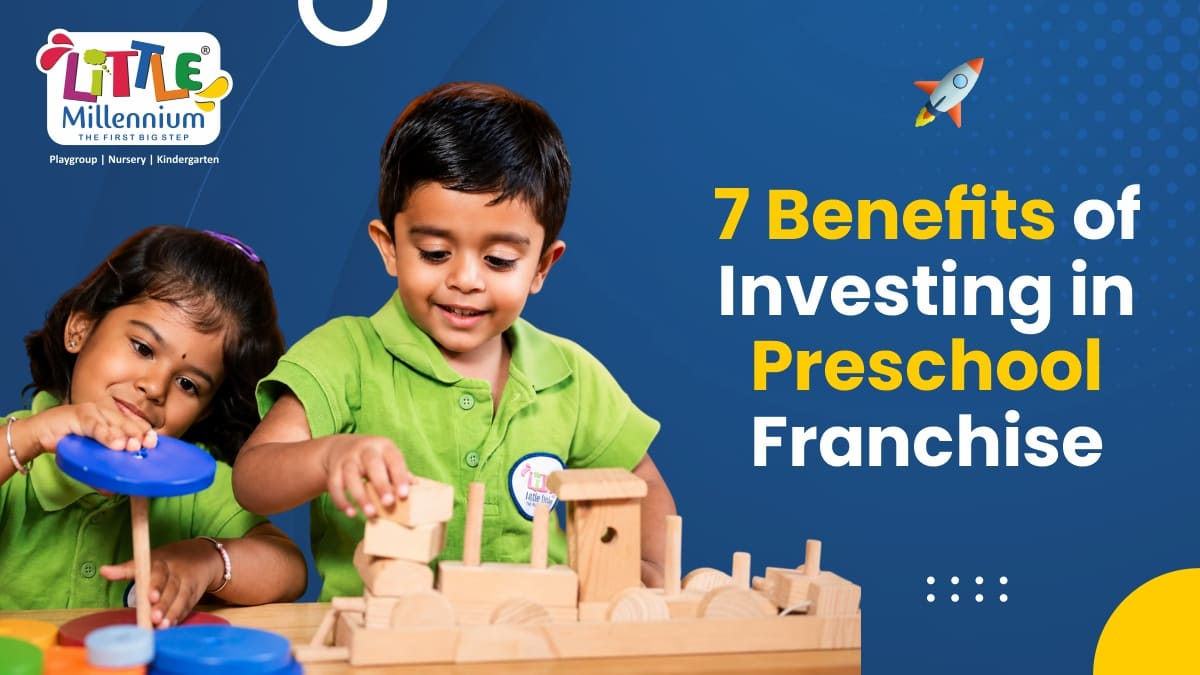
7 Benefits of Investing in the Best Preschool Franchise in India

The preschool industry in India is expected to grow from $5.1 billion (₹48,700 crore) in 2025 to $12.0 billion (₹1.15 lakh crore) by 2034, led by the NEP 2020 and increasing demand for high-quality early education.

A preschool franchise in India gives you a tried and tested curriculum, systems that have been proven to work and a brand that is already trusted, right from day one, instead of having to develop all this on your own.

How to Evaluate a Preschool Franchise in India

Not every preschool franchise is built the same. Before you commit to any brand, there are five things that separate a high-performing franchise from one that looks good on paper but underdelivers in practice.

  1. Brand recognition at the local level. Parents choose preschools based on trust. A brand that already has active centres in your city or region significantly reduces your admissions effort in year one.
  2. Curriculum quality and development coverage. Early childhood education research is clear: ages 2–6 are the highest-impact learning window.
  3. Make sure the franchise curriculum includes all developmental areas (cognitive, physical, social, emotional, language, creative and values) and is updated to reflect NEP 2020 guidelines. Transparency in fee and royalty structure. Get the full cost breakdown in writing: franchise fee, royalty or management fee (if any), kit costs, and renewal terms. Hidden fees erode your ROI faster than low enrolment does.
  4. Depth of operational support. Ask exactly what is covered: is staff recruitment support included? Is marketing on-ground or only digital? Does someone visit your centre regularly or is support limited to a helpline?
  5. Time to open and break-even track record. A faster launch means an earlier start to your first admission season. Ask the franchisor for a realistic onboarding timeline and then check with existing franchisees to confirm that this is what they experienced.

Here are seven tangible benefits of investing in a preschool franchise in India that will help you make an informed choice.

Benefit 1: You Start with a Brand Parents Already Trust

Building parent confidence is the main challenge for any new preschool. With no track record, most parents hesitate. A franchise solves this from day one. A widely known brand has immediate credibility as parents already know the name and first contacts are easy.

When evaluating any brand, look for active centres in at least 100+ cities — not just total numbers, but geographic spread. The wider the footprint, the stronger the word-of-mouth in your area from day one. Little Millennium’s 900+ centres across 175+ cities, serving 200,000+ families, is one benchmark worth applying to any franchise you compare.

Benefit 2: Access a Curriculum Built by Experts

Most independent preschools struggle with curriculum because it takes years of specialist expertise to build a quality framework.

With the best preschool franchise in India, the curriculum question is answered from day one. When assessing any programme, look for coverage of all seven early childhood development domains — cognitive, physical, social-emotional, language, creative, and values. A multi-sensory, research-based framework matters because it is also easier for staff to deliver consistently, which directly affects parent satisfaction and renewal rates. Little Millennium’s BLOOM Curriculum is a research-driven, play-based framework rooted in its award-winning Seven Petal Approach, it is built on exactly these principles, with newer additions like the BLOOM Wonder Hour and Settler’s Program making it easy for staff training and for parents’ clarity.

Benefit 3: A Preschool Franchise Business Model That Has Already Been Tested

Opening an independent preschool means experimenting with fees, staffing, admissions, and operations, often at inflated costs and with increased risk.

A proven preschool franchise business model eliminates much of this uncertainty. The method is honed by experience and determines every action, and you learn from the lessons of previous franchisees. Little Millennium’s five-year term provides new owners with structured onboarding, operational playbooks and setup guidance, and ongoing support to help the franchise achieve profitability. It is worth checking the fee structure of any brand you consider. Some investors specifically look for a preschool franchise with a transparent, predictable royalty and fee structure, so they know exactly how much of the centre’s revenue stays in the business. Always get the full cost and fee breakdown in writing before you sign.

Benefit 4: Support That Goes Further Than Most Owners Expect

Support is often promised by practically every franchise, but it might vary greatly from brand to brand in what you get. A strong preschool franchise support system in India makes it very easy to understand what is covered right from the beginning.

You’ll always have your own dedicated regional heads and marketing managers on the ground to give regular, hyperlocal and marketing design support.

What 360-Degree Support Includes

Support Area What It Includes
Centre Setup Collaborative planning from day one for location layout, furnishings, safety installations and branding materials ensures every centre is up to grade from the start.
Academic Training Full training is provided before opening, continued post-hire with curriculum-specific workshops and reinforced by continued professional development.
Recruitment of Staff Comprehensive guidance on recruiting qualified counsellors, implementing rigorous background screening and guaranteeing quality personnel.
Quality Starter Pack All centres are supplied with a quality starter pack and set-up items prior to Day 1, so the brand’s standards are in place from Day 1 of operations.
Marketing Help Marketing design help is provided throughout the year, along with hyper-local visits by regional heads and on-ground marketing managers for targeted outreach.
Ongoing Evaluation Regular class observation, professional development, and performance coaching is provided throughout the life of the franchise.

Benefit 5: Solid Financial Returns in a Structural Growth Market

The demand is constant and the business case of a preschool franchise is quite strong. More families seeking organised, branded early education means predictable, recurring revenue you can bank on.
A preschool franchise low investment entry point exists across the market, but price alone should not drive your brand decision. Curriculum quality, support depth, and network scale determine actual returns far more than the initial investment figure.

Little Millennium Franchise: Investment at a Glance

Parameter Details
Minimum Investment Starts from Rs 15 lakh (varies by location, city, and centre size).
Minimum Space Required 2,000 sq. ft. on the ground floor in a preferred residential area.
Franchise Term 5 years, with a renewal option based on performance evaluation.
Anticipated ROI 30–35% per annum (based on historical performance data*).
Break-even Timeline 12–24 months (industry average).
Onboarding to Opening 45 days after completing the onboarding process.

*Based on historical performance and industry benchmarks. Actual returns vary by location, market conditions, and management performance.

What Centres Are Achieving:

Based on historical performance, some centres have achieved annual returns in the 30–35% range and reached break-even within 12–24 months, though results vary by location, enrolment and operational execution.

Benefit 6: You Can Open Without a Teaching Background

A common misconception is that running a preschool requires a teaching qualification. However, that’s not true, especially for franchise owners. Your role is all about operations. Managing staff, keeping your centre’s standards high, overseeing admissions, handling finances, and building relationships in your community.

With a preschool franchise, you get comprehensive training that covers everything you need to run your centre smoothly. Little Millennium’s programme covers curriculum delivery basics, operations, compliance, and marketing fundamentals, delivered in two structured phases, both before and after opening. So if you are thinking about an early childhood education franchise in India but do not have a teaching background, this takes away one of the biggest barriers to entry.

Benefit 7: 45 Days from Decision to Opening

It can easily take six months to over a year to start an independent preschool from scratch, if licensing, construction, curriculum, and staffing all go well.

A franchise speeds up that process. Most Little Millennium franchisees go from onboarding to opening day in as little as 45 days after they have selected their location. All systems operational, curriculum ready to roll, compliance guidance tailored to your state’s standards. Getting in before a rival preschool or a new daycare franchise in India gives you a chance to captivate your target neighbourhood and set the tone for your very first admission season.

Conclusion:

If you’re evaluating preschool franchise opportunities, focus on curriculum quality, operational support, brand trust and financial transparency. The strongest franchise systems reduce risk while helping you reach profitability faster.

FAQs

Which is the best preschool franchise in India?

Ans: Many national brands exist, but Little Millennium stands out for its network, curriculum, and support.

What support does a preschool franchisor provide in India?

Ans: In India, preschool franchisors help set up your centre, provide learning materials, support staff hiring and training, offer ongoing development, marketing, and compliance guidance during the five-year franchise.

Why is a franchise better than starting an independent preschool?

Ans: With a franchise, you get a ready-to-use curriculum, a recognised brand, and established operational systems from the very beginning. This means you can avoid the hassle and expense of creating everything yourself, making it easier to get started and reach profitability sooner.

How does a preschool franchise help with marketing and student admissions?

Ans: The franchise backs you with regular marketing support. Local managers and leaders visit monthly. Admissions campaigns launch 5 to 8 weeks early, using local events, digital outreach, and branded resources to bring in new students.

What is the investment cost for a preschool franchise in India?

Ans: For a preschool franchise the investment in India is usually in the range of Rs 15 lakh depending upon brand and location. Returns of 30-35% per annum are expected and break even is achieved within one to two years.

Can I start a preschool franchise without any teaching experience?

Ans: You don’t have to be a teacher to own a franchise. Your role is to run the centre, the staff, admissions and community relations. During this period, Little Millennium provides extensive training on operations, curriculum delivery and continuous professional growth.

How much time does it take to start a preschool franchise after signing?

Ans: Most Little Millennium franchisees go from onboarding to opening in 45 days, with infrastructure, curriculum, compliance guidance, and marketing materials already in place.