
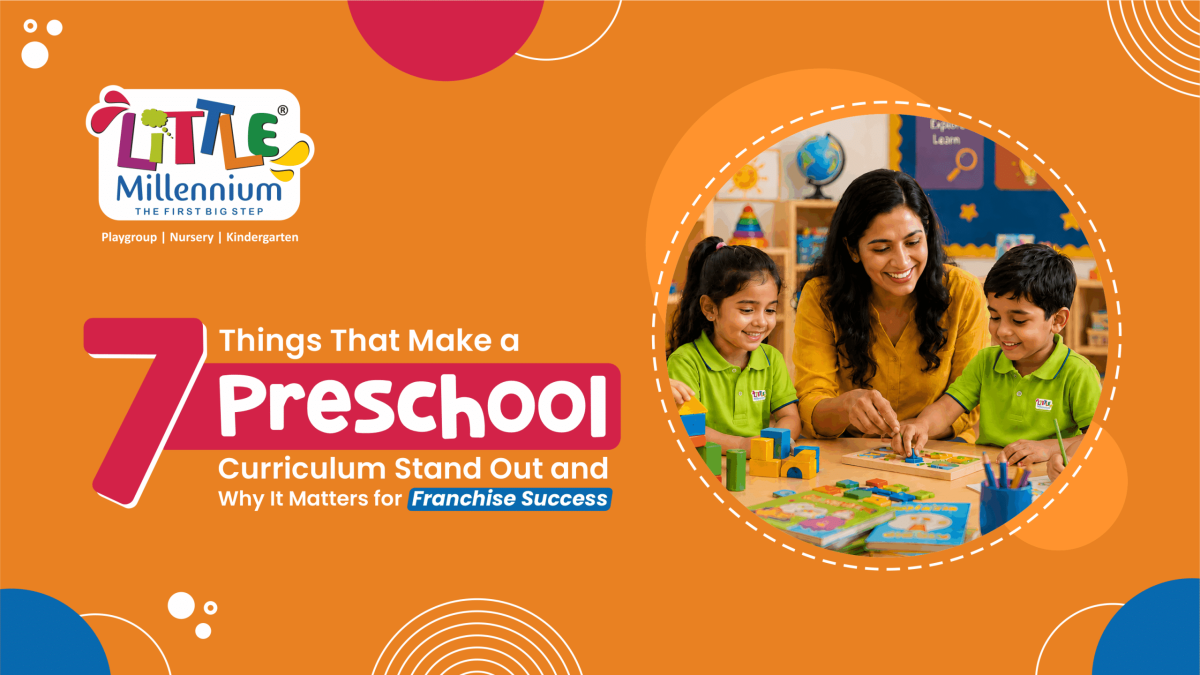
Every preschool advertises a curriculum. Few define what that word actually means once someone, a parent or a prospective franchisee, asks for specifics. Here’s what separates a preschool franchise curriculum worth choosing from one that’s mostly a paragraph of marketing language, and why the difference matters specifically for franchise success rather than just classroom quality.
1. It Has a Named, Recognisable Framework
“Structured learning” and “holistic development” show up in nearly every preschool’s marketing regardless of what actually happens in the classroom. A curriculum worth taking seriously names its framework outright. In India, that mostly means Montessori or the play-way method, sometimes a blend of both, rather than an undefined house style nobody can describe past the first sentence.
2. Montessori and Play-Way Are Genuinely Different Philosophies
Montessori is a structured approach built around a “prepared environment“: mixed-age classrooms, specially designed materials organised by subject area, and long blocks of uninterrupted work time in which children choose activities from a defined range of options rather than following free play. Play-way is more emergent by comparison. Rather than a fixed sequence of lessons, learning objectives get folded into child-led play, and the classroom tends to be more flexible and interest-driven as a result.
Neither approach is objectively better. What matters for evaluating a preschool franchise curriculum is that the brand can name which philosophy it follows and explain, specifically, how that shows up in a day’s schedule, not just describe both approaches in the abstract and imply the centre does a bit of everything.
3. It Aligns With Current National Standards
India’s National Curriculum Framework for the Foundational Stage treats hands-on, experiential learning as the primary teaching method for children in the early years[^c3], not an optional add-on layered onto an academic curriculum. Montessori’s self-directed materials-based approach and play-way’s free exploration both count as experiential learning in this sense, even though they differ from each other; a curriculum built primarily around worksheets and early rote instruction generally doesn’t, regardless of what it calls itself.
4. Its Learning Activities Cover Multiple Developmental Domains
Genuine preschool learning activities work across several areas at once: cognitive skills, fine and gross motor development, language, and social-emotional growth, rather than concentrating on one at the expense of the rest. A curriculum that’s mostly art projects, or mostly pre-literacy worksheets, is missing pieces a real early-years framework is supposed to cover together.
5. It’s Standardised Across Every Franchise Centre
This is where curriculum stops being a pedagogy question and becomes a franchise-success question directly. A parent who tours one centre and enrols expects the centre down the road, run by a different franchisee, to deliver the same thing. Curriculum as a franchise differentiator only works if it’s actually standardised: the same framework, the same activity structure by age group, and the same training given to every teacher regardless of location.
Without that consistency, a brand’s reputation gets built and damaged centre by centre instead of scaling as a single asset. A prospective franchisee evaluating any brand should ask directly how curriculum delivery is kept consistent across locations, not just whether a curriculum exists.
6. It Shows Real Age-Appropriate Progression
A credible preschool syllabus looks different for a two-year-old than it does for a five-year-old, building in complexity as children move through nursery and pre-primary stages rather than repeating the same activities at every age. If a nursery curriculum and the curriculum for the oldest children in the same centre look nearly identical, that’s usually a sign the framework wasn’t actually designed with developmental stages in mind.
7. It’s Specific Enough to Verify
The single clearest test: can the brand answer specific questions about its curriculum, or does every answer stay at the level of “we focus on holistic development”? A real curriculum has a name, a defined activity structure by age, a stated approach to teacher training, and, ideally, a track record across enough centres to show it’s actually been run consistently rather than described consistently.
Conclusion: Why Curriculum Quality Is a Franchise Success Question
A preschool franchise curriculum isn’t just a pedagogy choice: it’s an operational promise that has to hold up identically across every centre a brand ever opens. The seven things above aren’t really about picking Montessori over play-way or vice versa. They’re about whether a curriculum is specific and consistent enough to actually deliver what it claims, centre after centre, rather than sounding good in one conversation and falling apart in the next.
Explore how curriculum consistency works across Little Millennium’s network: https://www.littlemillennium.com/franchise-with-us/
Key Takeaways:
- A standout preschool franchise curriculum starts with a named, recognisable framework. Montessori and the play way method are the two most common in India, rather than vague claims of “holistic learning.”
- Montessori and play-way represent genuinely different philosophies. Montessori uses structured, sequential, self-directed activities with specialised materials, while play-way is more emergent, built around free exploration and guided play.
- Whichever framework a curriculum uses, it should now line up with India’s National Curriculum Framework for the Foundational Stage, which sets play based learning as the current national standard for the early years.
- Preschool learning activities that cover cognitive, motor, social, and language development together, not just one of them, are what separate a real curriculum from a loose activity schedule.
- For a franchise specifically, curriculum consistency across every location matters more than which philosophy gets chosen, since uneven delivery between centres is what actually damages a brand’s reputation.
- A strong preschool syllabus shows real age-appropriate progression, not the same activities repeated regardless of a child’s age or stage.
- The clearest sign of a real curriculum is that it’s specific enough to check: a named framework, defined activities by age group, and teacher training tied directly to delivering it.
Frequently Asked Questions
A named pedagogical framework, activities that cover cognitive, motor, language, and social development together, age-appropriate progression from nursery through pre-primary, and a defined approach to training teachers on that specific curriculum rather than general childcare skills.
Because it’s the thing parents are actually paying for and the thing hardest for a franchise to fake past a first impression. A weak curriculum shows up in slower enrolment, more parent complaints, and centres that struggle to differentiate themselves from unbranded competitors nearby.
It means a parent’s experience at one centre predicts their experience at another, which is what lets a brand’s reputation compound across locations instead of resetting at every new centre. Without standardisation, a strong centre in one city does nothing for admissions in the next.
Neither is inherently better; both meet current national standards when implemented properly. What matters more for franchise success is whether the brand delivers its chosen approach consistently across every centre, not which philosophy it picked.
A syllabus is the structure, what gets covered and in what order as children move through age groups. Learning activities are what actually happens inside that structure day to day, the specific games, materials, and exercises used to deliver it.
At Little Millennium, we make the early years count through a scientifically designed, developmentally appropriate, play-based curriculum that nurtures each child’s uniqueness and builds a strong foundation, academically, socially, and emotionally preparing them for future learning and success.