
Between companies announcing another round of layoffs and another appraisal that falls short of expectations, many salaried professionals are asking themselves a different question. Not the Excel-sheet kind, rather a simpler one. What happens if this job, this company or even this industry, no longer needs me in 5 years?
For some, the answer in not quitting their jobs to become entrepreneurs overnight. It is to build something alongside – while working 9 to 5. This is why preschool franchise for corporate professionals are increasingly finding their way into conversations among corporate professionals. WhatsApp groups, LinkedIn discussions or even casual house party conversations are starting to discuss a question that would’ve sounded unusual a few years ago. What if I owned a business of my own?
A preschool franchise for professionals is one of the ways. It allows professionals to continue with their careers while gradually building a business and a second source of income.
The Quiet Shift Behind Corporate India’s New Investor Class
The desire to have a second income stream is not surprising. The job market is changing fast, professionals are switching roles, competition in good jobs are increasing, and AI is already changing the nature of several mid-level jobs. For someone who has spent years building a corporate career, having their financial security tied to one salary, is becoming increasingly uncomfortable.
At the same time, entrepreneurship and side business for salaried professionals is becoming accessible. You no longer necessarily need to build a business from scratch, build a brand from zero and figure out processes on your own.
This is where franchising comes in. Preschool education, in particular, has emerged as an interesting option for investors looking at long term businesses. Early childhood education has also gained more policy attention under the National Education Policy, making the sector that many investors are watching closely.
What is the Preschool Franchise Business Model?
For someone considering their first business, the biggest attraction of a franchise is the structure. Established preschool brands such as Little Millennium operate on a Franchise Owned, Franchise Operated (FOFO) model. The franchisee owns and operates the centre while the brand provides the framework, curriculum, training and support to set up and run it. This support can be significant.
Starting and running one of the best franchises for salaried employees in India on their own means developing a curriculum, hiring and train teachers, establish operating processes, build local reputation and figure out everything from marketing to compliance. A franchise brings all of these under an established system.
Little Millennium follows its BLOOM curriculum and supports franchisees in the centre setup process, with the journey from onboarding to opening taking around 45 days. For a professional who still has a full-time job, that kind of structured setup can be much more practical than spend a year figuring everything out independently.
The scale of an established network can also provide reassurance to first time investors. Little Millennium has a presence in 175+ cities and 900+ centres, offering prospective franchisees a scalable opportunity of preschool franchise for corporate professionals to enter a business model that has been implemented across different markets.
Preschool Franchise Investment for Corporate Professionals: What to Consider?
The practical side of the decision starts with this question. A prospective franchisee needs to look beyond the brand name and understand the investment, size of the centre, location, operating costs and time it will take to stabilize.
For example, a preschool franchise investment can start at around ₹15 lakh for a centre of 2,000 sq. ft, depending on the location and format. The actual investment can vary significantly based on city, property and centre requirements. A franchise business for working professionals in India is a more approachable opportunity than a completely new business.
But the financial equation needs to be looked at realistically. Some preschool franchise business models may project ROI of 30-35%, with break-even taking around 12-24 months once the operations stabilize. These are indicative figures, not guaranteed returns. Location, admissions, operating costs, pricing and quality of execution can all influence the actual outcome.
The bigger attraction for many professionals is therefore not a possibility of earning more than their annual salary increment. It is diversification. A business can become a second income stream and potentially expand an asset. That changes the financial equation of reliance on a monthly salary to have more than one source of income.
You Don’t Have to Quit Your Job to Start a Preschool Franchise
There is one obvious question every working professional asks. “Who is going to run this while I’m sitting in meetings all day?” This is where the preschool franchise business model comes in.
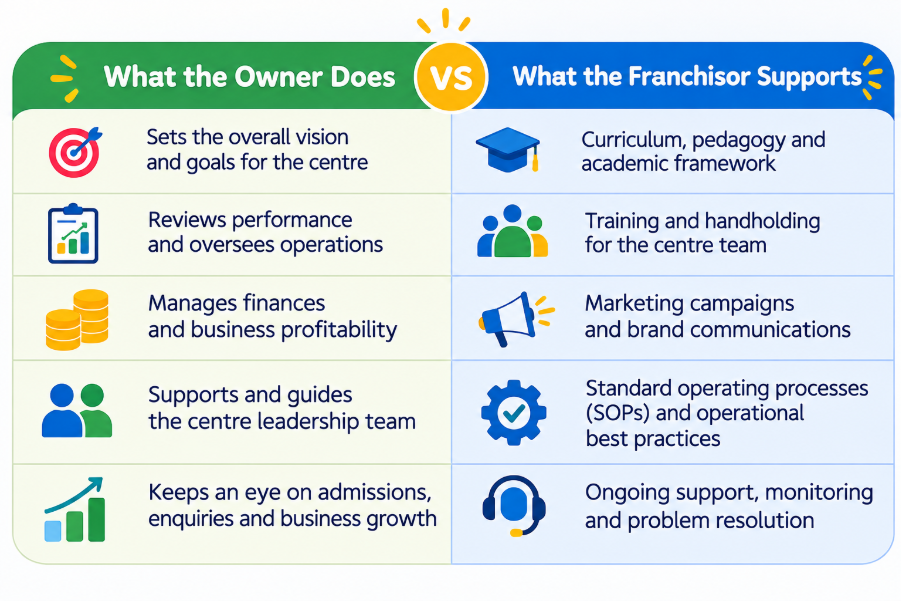
With an established preschool brand, the centre typically has an on-ground team handling operations, while franchise management team support across academics, training, marketing operations.
For a franchise owner, the role is less about being physically present every day but more about being involved in the decisions that matter, reviewing performance, managing finances, supporting the centre leadership team and keep an eye on admissions and operations.
But it is important to be clear that a preschool franchise is not a passive investment.
It still requires ownership, oversights and decision-making, particularly in the early stage. The advantage is that the business model and support system can make it possible to manage alongside a full-time career.
For professionals looking for a preschool franchise that can fit around their existing careers, this distinction matters.
The Bigger Picture
For a long time, the idea of a side business for working corporate professionals meant trading stocks after work, starting an online store or experimenting with a small venture on weekends.
Business ownership is beginning to look different. A preschool franchise combines a physical, community-based business with an established operating framework. It requires effort and attention, but it also gives professionals an opportunity to build something that is theirs.
And that might be the real shift. The goal isn’t necessarily to walk away from a successful corporate career, but to build something alongside. For professionals who have spent years working towards promotions, increments and better titles, owning a business service like best preschool franchise can provide a different kind of progression from earning a salary to building an asset of their own.
Frequently Asked Questions
For many it is about diversification. A franchise allows them to explore business ownership without necessarily giving up their existing career, allowing them another potential income stream while building an asset over time.
It can be managed alongside a full-time career when the centre has a capable on-site team and franchisor provides adequate operational support. However, the owner still has to be involved in reviewing performance and making important business decisions.
It is better viewed as a managed business. While franchisor and centre team can take care of several operational responsibilities, the owner still has to provide oversight and be involved in the business.
There is no single answer. Earnings depend on factors such as location, admissions, fees, operating costs and how the centre is managed. Some franchise models may project ROI of 30-35% once stabilized, but these figures should always be looked at in the context of a business plan and local market.
Quite a few! Managing teams, understanding of P&L, working with vendors, negotiating, communicating with stakeholders and tracking performance through KPIs are all useful skills for a business owner. In fact, many of the practices that help someone succeed in a corporate role can become just as handy when running a business of their own.

At Little Millennium, we make the early years count through a scientifically designed, developmentally appropriate, play-based curriculum that nurtures each child’s uniqueness and builds a strong foundation, academically, socially, and emotionally preparing them for future learning and success.