
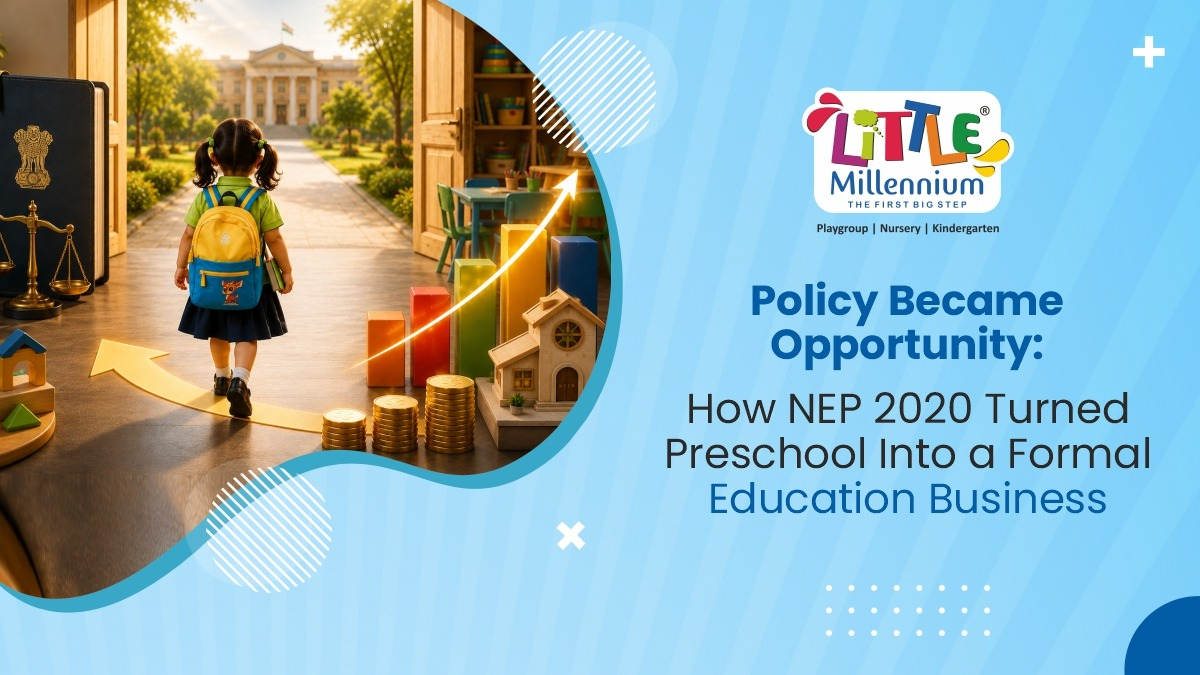
For years, preschool in India was treated as a “before school” phase. Parents valued it, but the education structure itself started at Class 1. NEP 2020 changed that. It placed the early years inside the school education framework, and in doing so, it changed how families, educators and entrepreneurs look at early childhood education.
If you are exploring a preschool franchise business, this shift is worth understanding. Here is what the policy says, what it has changed, and how Little Millennium is set up to work within it.
What does NEP 2020 say about preschool education?
NEP 2020 replaced the old 10+2 structure with a 5+3+3+4 structure. Under the earlier system, children between 3 and 6 years were not part of the school structure, because Class 1 began at age 6. The new structure starts at age 3.
The first stage is the Foundational Stage, which covers ages 3 to 8. It includes three years of early childhood care and education (ECCE) at an Anganwadi, Balvatika or preschool, followed by Classes 1 and 2. The policy also names stand-alone preschools among the institutions that deliver ECCE, and it asks for educators who are specially trained in early childhood curriculum and pedagogy.
Is preschool education formal education in India?
NEP 2020 brings preschool into the formal structure of school education. Ages 3 to 6 are now the first part of a child’s schooling journey, not something that sits outside it. That recognition is the real change. Early education is no longer seen as optional preparation. It is seen as the foundation for everything that follows.
From Anganwadi to preschool: a wider focus on the early years
The Anganwadi to preschool transition is part of the same shift. NEP 2020 talks about strengthening Anganwadi centres and introducing a Preparatory Class, or Balvatika, before Class 1. The Ministry of Education has also asked states and UTs to align Class 1 admission to age 6 and above, so that the three preschool years are a real part of every child’s learning. The result is a stronger national focus on what happens between ages 3 and 6.
The National Curriculum Framework for the Foundational Stage
In October 2022, NCERT released the National Curriculum Framework for the Foundational Stage (NCF-FS). It sets out how learning should look across ages 3 to 8, with play-based, activity-based and developmentally appropriate learning at the centre.
For parents, this gives a clearer picture of what good early education looks like. For anyone running a preschool, it sets a clear direction for curriculum and classroom practice.
Read Also: How to Evaluate and Choose the Right Preschool Franchise Opportunity
What the Foundational Stage asks of a preschool
The Foundational Stage is built around how young children actually learn: through play, movement, stories, conversation and hands-on activity. NEP 2020 recommends that children be taught in their home language or mother tongue in the early years wherever possible, and the NCF-FS describes assessment in this stage as observing children and looking at the work they produce, rather than relying on formal tests.
In simple terms, a preschool that follows this approach is less about early pressure and more about curiosity, confidence and a love of learning. That is a direction many parents already want for their children, and it is one that a well-designed curriculum can support.
Why trained teachers sit at the centre
Both NEP 2020 and the Ministry of Education have been clear that the quality of early education depends on the people delivering it. The policy proposes certificate and diploma programmes in ECCE for Anganwadi workers and teachers, and the Ministry has advised states to consider a two-year Diploma in Preschool Education.
For a preschool, this puts teacher selection, training and ongoing coaching at the heart of the operation. It is also one of the first things a prospective franchise partner should ask any brand about.
NEP 2020 impact on the preschool industry
Policy does not build a business on its own, but it changes expectations. A few things stand out:
- Parents are asking more informed questions about curriculum and teaching approach.
- Play-based learning is now the stated national direction for ages 3 to 6.
- Trained, well-supported educators are central to the policy’s vision.
- Early childhood education is being discussed as part of the larger education system, which is a more serious position than it held before.
This is why many people describe NEP 2020 as an education policy driven business opportunity. The demand for good early learning has always existed. The policy has given it more visibility and more shared language.
As early education gets more attention, the preschool sector in India is likely to see closer conversations around curriculum quality and teacher training. For anyone entering the regulated preschool sector in India, or watching it develop, it helps to work with a brand whose curriculum already follows national frameworks such as NEP 2020 and NCF-FS, and whose centres are supported with training and operational guidance. That kind of groundwork makes it easier to adapt as expectations evolve.
How Little Millennium is set up for this
Little Millennium has over 900 preschools across 175+ cities in India. Our BLOOM curriculum is aligned with NEP 2020 and NCF-FS, and it is implemented across all Little Millennium preschools. It builds on the Seven Petal Curriculum that has guided our centres for over 16 years.
BLOOM is built around seven developmental areas: physical development, literacy, numeracy, creative expression, personal, social and emotional development, cultural and environmental awareness, and life skills and talent. It also includes the BLOOM Wonder Hour, a module that encourages children to explore, question and create. Alongside the curriculum, we place weight on teacher training, coaching and feedback, because a good curriculum only works when it is delivered well in the classroom.
BLOOM follows a knowledge, skills and values approach, and our classrooms use multi-sensory, movement-based and play-based activities so that children learn in ways that feel natural to them. The aim is simple: children who are confident, curious and ready for the next stage of school.
For a franchise partner, this means you are not designing a curriculum from scratch or guessing at policy alignment. You begin with a framework that is already in place, supported by training and operational guidance from our team.
Is a preschool franchise a good investment because of NEP 2020?
NEP 2020 makes the early years more visible, and that is a helpful backdrop. But a preschool is a local, relationship-driven business, and its success rests on fundamentals:
- the right location and catchment
- trained, motivated teachers
- a curriculum parents can understand and trust
- consistent operations and support from the franchisor
- an owner who stays involved in the centre
This is where the choice of brand matters. A franchise partner benefits from a tested curriculum, training, academic support, marketing assistance and ongoing guidance, so that the day-to-day work is not carried alone.
How does NEP 2020 benefit preschool franchise owners?
In practical terms, the policy environment can help a well-run centre in a few ways:
- It gives you a clear, government-backed way to explain to parents why the early years matter.
- It supports a curriculum direction built on play-based, developmentally appropriate learning, which is what BLOOM is designed around.
- It increases the importance of trained educators, an area where franchisor support makes a real difference.
- It helps position a preschool as part of the education journey, not only as childcare.
What to look at before you decide
Whichever brand you consider, a few practical steps are worth taking. Visit a few operating centres and see a classroom in action. Speak with existing franchise partners about their experience. Ask how teachers are recruited, trained and supported. Understand the investment, space requirements and the support you can expect after launch. And read the franchise agreement carefully before you commit.
We are happy for prospective partners to ask these questions. A preschool is a long-term commitment, and it works best when both sides begin with clear expectations.
Who can start a Little Millennium preschool?
Prior experience in education is not mandatory. Our franchise partners include working professionals, business owners, investors, women entrepreneurs and NRIs. The total investment starts from ₹15 lakh, depending on the location, size of the centre and city, and the minimum property size is 2,000 sq ft.
Take the next step
If you are thinking about starting a preschool, the best place to begin is a conversation. , download the franchise brochure, and speak to our team about what ownership looks like in your city.
Frequently Asked Questions
It includes three years of preschool (ages 3-6) in the Foundational Stage of the 5+3+3+4 structure, followed by Classes 1 and 2. It calls for play-based learning and trained ECCE educators.
It brings ages 3-6 into the school structure, which earlier began at Class 1. NCF-FS (2022) then set out the curriculum approach for ages 3-8.
Under NEP 2020, preschool is part of the Foundational Stage, the first stage of school education.
Early Childhood Care and Education covers the years before Class 1, delivered through Anganwadis, Balvatikas and preschools, with a focus on holistic, play-based development.
Released by NCERT in October 2022, it guides learning for ages 3-8 across preschool and Classes 1-2.
NEP 2020 aims to strengthen Anganwadis and introduce a Preparatory Class (Balvatika) before Class 1, so every child gets a more structured early learning experience.
NEP 2020 raises the profile of early education, but results depend on location, teachers, parent trust and franchisor support. We encourage every prospective partner to visit centres and speak to existing partners first.
It gives a shared language to explain early learning to parents and a curriculum direction to build on. BLOOM is aligned with NEP 2020 and NCF-FS.
Yes. BLOOM is aligned with NEP 2020 and NCF-FS and is implemented across all Little Millennium preschools.
No. Prior experience in education is not mandatory.
The total investment starts from ₹15 lakh, depending on location, centre size and city. The minimum property size is 2,000 sq ft.
At Little Millennium, we make the early years count through a scientifically designed, developmentally appropriate, play-based curriculum that nurtures each child’s uniqueness and builds a strong foundation, academically, socially, and emotionally preparing them for future learning and success.