
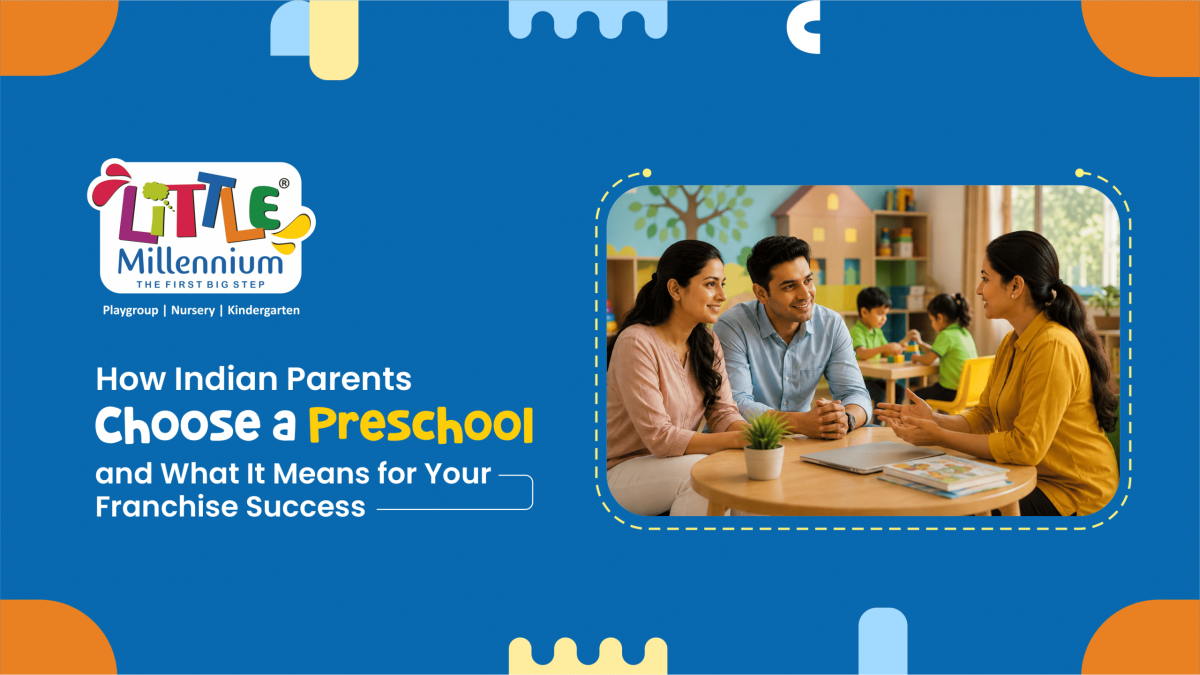
Every parent on a preschool tour is running an evaluation, whether they realise it or not. For anyone building a preschool franchise or evaluating what makes the best preschool franchise in India, understanding what that evaluation actually weighs matters more than any brand tagline. What follows is what the evidence shows Indian parents look for, and what it means for a preschool franchise in India trying to turn tours into enrolments.
What Indian Parents Actually Prioritise
Preschool parent expectations aren’t mysterious. They follow a fairly consistent pattern, and it starts with safety.
Safety and Verified Staff
Under POCSO Rules 2020, any institution housing children, preschools included, must run periodic police verification and background checks on every staff member who comes in contact with children, along with regular child-safety training for that staff. This isn’t a preschool-specific nicety; it’s a legal requirement. Parents increasingly know this, and a centre that can’t confirm it during a tour loses trust immediately.
A Curriculum That’s More Than a Brand Promise
Parents are evaluating preschool curriculum even when they don’t have the vocabulary for it. They notice whether a day feels structured or improvised, whether activities build on each other, and whether the approach matches national guidance instead of looking made up on the spot.
Teacher Ratios and Real Attention
Dedicated early-childhood educators remain rare across India’s pre-primary sector, present in as few as 9% of pre-primary schools, against a recommended maximum of 20 children per teacher. Parents may not quote that statistic, but they notice its effects: a teacher stretched across too many children can’t give any one child much attention, and that shows during a visit.
Transparent Fees and Communication
Fee structures that surface fully only after enrolment, or communication that goes quiet once a child is enrolled, are common frustrations. Parents increasingly expect the full annual cost in writing before committing, and ongoing updates once their child starts.
Why Preschool Curriculum Comes Before Brand in a Parent’s Mind
NCERT’s National Curriculum Framework for the Foundational Stage, released in 2022, sets play as the primary teaching method for the early years. It’s the baseline the framework is built around, not an optional layer a preschool can choose to add. A parent’s instinct that a preschool “feels different” is often just a reaction to whether the curriculum is genuinely structured this way, or whether play-based learning is a phrase on a brochure rather than something the classroom does hour to hour.
For a preschool franchise in India, this means curriculum has to hold up in the room, not just on paper. A brand whose curriculum is compliant, documented, and visible in how a class actually runs earns trust faster than one leaning on recognition alone.
What Preschool Franchise Success Actually Depends On
Preschool franchise success comes down to converting the priorities above into what a prospective parent can see and check for themselves. A franchise that can show, not just tell, tends to win parents over.
| What Parents Look For | What a Franchise Needs to Show |
|---|---|
| Safety | Police-verified staff and visible safety protocols, not just a claim |
| Curriculum | A named, NCF-FS-aligned framework, demonstrated in the classroom |
| Teacher attention | A real, disclosed teacher-to-child ratio |
| Fees | The full annual cost in writing before enrolment |
| Ongoing trust | Regular, specific communication once a child is enrolled |
Little Millennium’s own model reflects this translation directly: a 10:1 teacher-to-student ratio well inside the recommended maximum, curriculum development credentials that are documented rather than assumed, and a 360° support system that holds franchisees accountable to these standards instead of leaving them open to interpretation.
How a Preschool Franchise Can Attract More Parents in India
Beyond meeting the criteria above, a few practical steps move the needle on local admissions:
- Publish safety protocols and curriculum framework details in the centre’s own materials, not only in corporate marketing.
- State the teacher-to-child ratio as a fact, not a vague reassurance.
- Get the full annual fee in writing before a parent has to ask.
- Keep communication active after enrolment, not only during the sales process. Word of mouth is widely considered of new admissions in this sector.
- Use the franchisor’s marketing and regional support where available, rather than building local awareness entirely from scratch.
What Sets the Best Preschool Franchise Brands Apart
Parents comparing options aren’t usually comparing logos. Whether consciously or not, they’re comparing exactly the criteria above: verified safety, a real curriculum, disclosed ratios, and transparent fees. The best preschool franchise brands are the ones whose systems make these things checkable, not merely promised. That’s also, not coincidentally, what separates a franchise worth a first-time owner’s consideration from one that’s mostly marketing.
Conclusion: What Parent Priorities Mean for Franchise Success
Indian parents aren’t choosing based on brand alone, and they haven’t been for a while. What decides the outcome is whether a centre can back up its claims once a parent starts asking specific questions. The best preschool franchise in India, and the franchise most likely to succeed locally, is the one built to answer those questions clearly rather than talk around them.
Explore how Little Millennium’s model translates parent priorities into franchise support: https://www.littlemillennium.com/franchise-with-us/
Frequently Asked Questions
Safety and verified staff come first, followed closely by curriculum structure, teacher-to-child ratio, and transparent fees. Brand recognition matters, but it rarely overrides a poor showing on any of these first four.
By making the criteria parents already care about visible and verifiable rather than assumed, showing proof of safety compliance, naming the curriculum framework outright, disclosing the actual teacher ratio, and putting the full fee structure in writing before anyone has to ask. Consistent communication after enrolment also drives word-of-mouth referrals, which are considered to account for much of new admissions.
Profitability depends more on execution, location, and how well a centre delivers on parent priorities than on the franchise brand alone. A well-run centre with the right catchment and a transparent, compliant curriculum tends to reach stable enrolment faster, which is usually the larger factor in profitability.
A structured, age-appropriate curriculum aligned with current national standards, specifically play-based learning under NCF-FS, not rote instruction or unstructured activity time. Parents tend to notice the difference even without naming the framework.
More important than many franchises assume, even when parents don’t cite a number. Nationally, dedicated early-childhood teachers are rare, present in only about 9% of pre-primary schools, against a recommended cap of 20 children per teacher. Parents notice the effects of a stretched ratio during a visit, even without knowing the statistic behind it.
Usually, yes, at least as the first filter. A preschool that can’t confirm police-verified staff tends to lose trust immediately, regardless of curriculum quality. Once safety clears, curriculum becomes the next major factor in the decision.