
Pune’s IT and startup boom is creating a large base of working parents who want structured, high-quality early learning close to home. That makes a preschool franchise in Pune one of the more promising ways into the city’s education sector. Dual-income families need trained teachers, safe campuses and longer hours, and a franchise gives new owners a proven system to deliver all three from day one.
Key Takeaways
- Pune’s IT hub keeps drawing young salaried families with children under six.
- Working parents are moving from neighbourhood playgroups to structured preschools.
- Demand is likely strongest near tech clusters such as Hinjewadi, Kharadi, Baner, Wakad and Magarpatta.
- A franchise lowers the risk of a first-time preschool startup.
- Location, staffing and franchisor support matter as much as the investment figure.
- Little Millennium’s franchise investment starts from ₹15 Lakhs to ₹30 Lakhs (as of 16 October 2026).
Thinking of getting started? Explore the Little Millennium franchise model
How Pune IT Growth Is Driving Preschool Franchise Opportunities
Pune’s IT growth drives preschool franchise opportunities by bringing in thousands of young professionals who need reliable, structured childcare and early learning. As more families settle near tech parks, the number of children reaching preschool age rises, and so does the number of parents willing to pay for quality.

The scale shows up in official numbers. STPI-registered units under STPI-Pune’s jurisdiction, which is headquartered in Hinjewadi, contributed ₹1.83 lakh crore in IT, ITeS and ESDM exports in FY 2023-24, according to STPI-Pune (Ministry of Electronics & IT). Many of the people behind those numbers are in their late twenties and thirties, which is when families have young children. They often live far from grandparents, work hybrid hours and judge schools online. Unorganised playschools rarely meet all of that, and that gap is where premium brands step in.
Why Pune Is a Good City for a Preschool Franchise Business
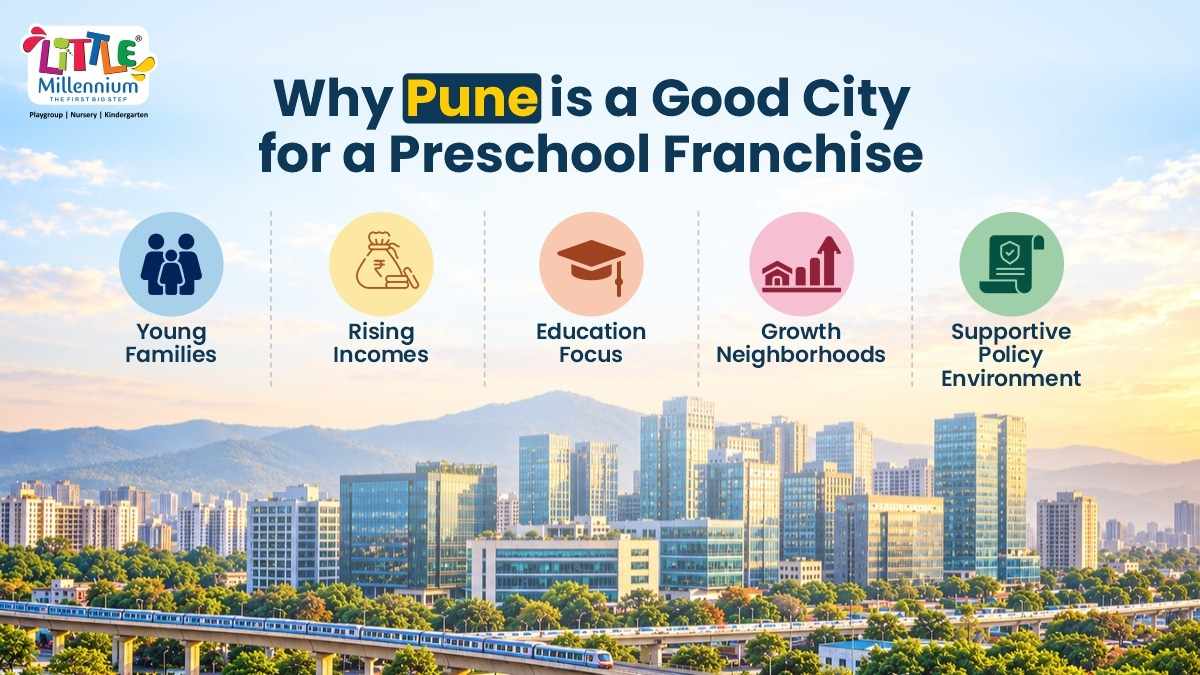
Pune is a good city for first-time preschool owners because it combines a young parent base, strong household incomes, a deep education culture and demand spread across many neighbourhoods. Owners are not tied to a single catchment, and parents here compare quality closely.
- Young, mobile workforce: IT, fintech, SaaS and manufacturing keep adding families.
- Spending on early learning: Parents see the first five years as the base for later schooling.
- Several growth pockets: West Pune, East Pune and the newer suburbs each have their own demand.
For anyone studying the Pune preschool market or the wider education business in Pune, preschools need less space and capital than a full school, yet they serve a recurring, loyal customer base. Policy helps too. Under the National Education Policy, the foundational stage covers ages 3 to 8, including three years of preschool, as the Department of School Education & Literacy (April 2025) reiterated in its letter to states.
Why Premium Preschools Are Replacing Basic Playgroups
Premium preschools are replacing basic playgroups because working parents want more than supervision. They look for a structured curriculum, trained staff, secured premises and regular updates they can check for themselves.
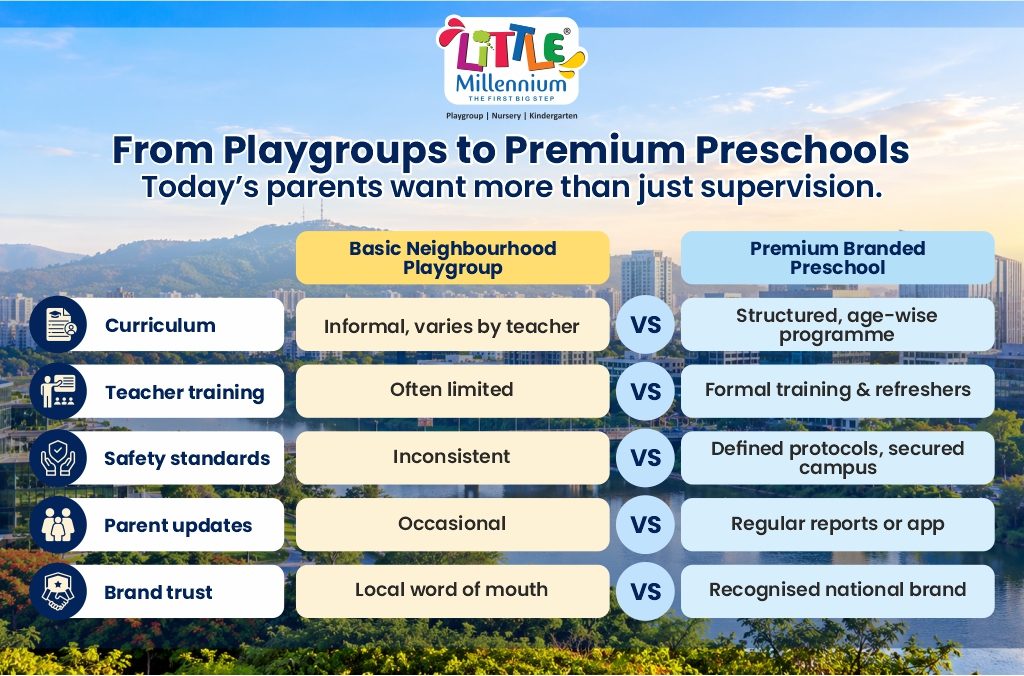
| Factor | Basic neighbourhood playgroup | Premium branded preschool |
| Curriculum | Informal, varies by teacher | Structured, age-wise programme |
| Teacher training | Often limited | Formal training and refreshers |
| Safety standards | Inconsistent | Defined protocols, secured campus |
| Parent updates | Occasional | Regular reports or app |
| Brand trust | Local word of mouth | Recognised national brand |
This shift explains the growing demand for preschools with proper systems behind them, and the rising interest in the early childhood education business. A curriculum aligned with national standards, such as Little Millennium’s BLOOM curriculum, is often the first thing parents ask about.
What a Preschool Franchise in Pune Means for Investors
For investors, the trend points to a real preschool business opportunity in Pune, and a franchise lets you tap it without building a curriculum, training programme and reputation from scratch. A good preschool franchise opportunity in Pune also supports you after signing, not just before.
Many people searching for the best preschool franchise in Pune are really asking which brand will make a first venture less risky. Check these points:
- Years of operation and number of running centres
- The curriculum and how often it is updated
- Training for teachers and centre heads
- Written terms on fees, royalties and launch support
Preschool Franchise Investment in Pune: What to Expect
A preschool franchise investment in Pune usually covers the franchise fee, rent and deposit, interiors, learning material, staff and launch marketing. Costs vary by brand and city, so ask for a written breakup. Here are Little Millennium’s current terms:
| Parameter | Little Millennium (as of 16 October 2026) |
| Investment Range | ₹20 Lakhs to ₹30 Lakhs; depending on location and centre size. |
| Minimum property size | 2,000 sq ft |
| Anticipated ROI | Approximately 25–30% per annum |
| Agreement term | 5-year initial term, with renewal subject to performance and mutual agreement |
| Network | 900+ centres |
Source: Little Millennium franchise page, as of 16 October 2026. ROI is anticipated, not guaranteed, and varies by centre.
A sound franchise investment is one where both sides are open about costs and risks. Running a preschool franchise business in Pune also needs hands-on involvement, because parents notice when an owner is present. Before you decide, read the common challenges of starting a preschool franchise in India and how to get past them.
How to Start: A Simple 5-Step Path
- Research your micro-market. Count existing preschools and note parent footfall near tech parks.
- Shortlist two or three franchisors. Compare track record, support and documentation.
- Visit running centres. Ask franchisees what they wish they had known earlier.
- Secure a suitable location. Check it meets the franchisor’s size and safety guidelines.
- Hire, train and launch. Recruit staff, complete training and begin pre-launch admissions.
For a first preschool startup, this route shortens the learning curve and lets you focus on the local community.
Brand Perspective: Little Millennium on Pune’s Preschool Demand
Little Millennium sees working-parent households as a clear signal of where early learning is heading. Announcing BLOOM in September 2025, its leadership team said it is “shaping not just preschool education but the future of ECCE in India”.
“With BLOOM, we are shaping not just preschool education but the future of ECCE in India. Every child’s natural potential is nurtured with care, creativity, and relevance — preparing them for tomorrow’s world while preserving the essence of childhood.”
[Geetika Bahuguna, COO (Academics), Little Millennium]
For franchise partners, that consistency of curriculum, safety practice and teacher training is what builds trust in a new neighbourhood.
Conclusion
Pune’s tech parks, startups and young families are reshaping how parents choose early education. For investors who want a purpose-driven venture, a preschool franchise in Pune offers a way to meet that demand with a tested model. Study your micro-market, compare franchisors on facts, and pick a partner whose standards you would trust with your own child.
Ready for a detailed conversation? Talk to the Little Millennium franchise team
Frequently Asked Questions
Yes, especially under a franchise model. You get a ready curriculum, training and brand recognition, so you can focus on admissions and parent relationships. Results still depend on location, staff quality and steady owner involvement, so plan for active participation in the first year.
Look for a proven curriculum, transparent costs, strong training and ongoing support. Compare brands on years of operation, centre count and franchisee feedback. Visit running centres, and get fees, royalties and the agreement term in writing before you commit to any brand.
It depends on the franchisor. Little Millennium’s minimum property size is 2,000 sq ft as of 16 October 2026. Ideally the space fits classrooms, an activity area, washrooms, reception and safe play space, with easy access for parents at drop-off and pick-up.
Neighbourhoods near large IT clusters, such as Hinjewadi, Kharadi, Baner, Wakad and Magarpatta, tend to have many working-parent families. Verify with your own survey of local competition, fees and household incomes before choosing a site.
No. Owners usually manage operations while qualified teachers and a centre head handle academics. Franchisor training helps you understand the curriculum, but hiring and retaining good staff is what keeps parents confident in the centre.

At Little Millennium, we make the early years count through a scientifically designed, developmentally appropriate, play-based curriculum that nurtures each child’s uniqueness and builds a strong foundation, academically, socially, and emotionally preparing them for future learning and success.