
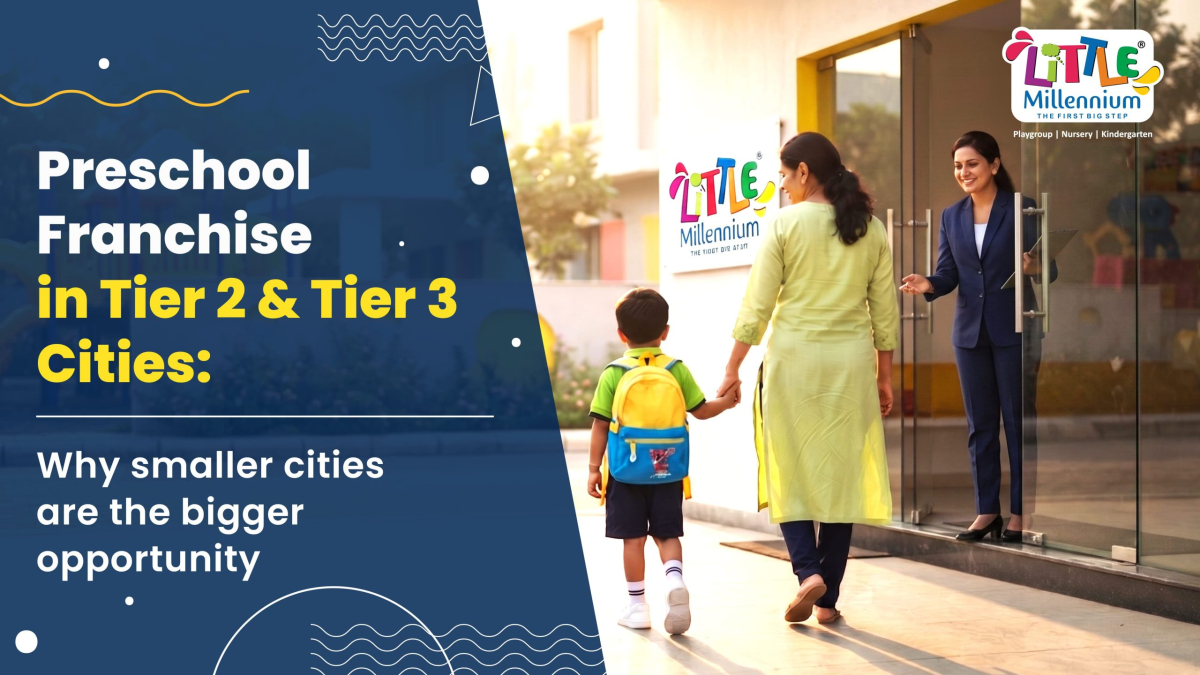
India’s preschool market is on track to grow from roughly USD 5.1 billion in 2025 to USD 12 billion by 2034. For years, that growth got absorbed almost entirely by the metros. That’s changing. A meaningful share of new demand for a preschool franchise in India is now coming from Tier 2 and Tier 3 cities, and for anyone evaluating where to open next, that shift changes the calculation.
Why the Growth Is Moving Past the Metros
Metro cities got the first wave of branded preschools because that’s where organised early education demand showed up first: dual-income households, higher awareness, and enough disposable income to pay a premium for a structured curriculum. That wave has mostly played out. Most viable metro catchments already have two or three branded centres competing for the same pool of families.
Smaller cities are catching up on the underlying conditions that made metro demand work in the first place. Housing developments, new job hubs, and rising incomes have reshaped cities that didn’t have this kind of demand a decade ago. Families moving into these areas want the same things parents in metros want: structured routines, trained staff, and a brand they’ve at least heard of. Someone searching for a school franchise in India today is as likely to be looking at a Tier 2 city as a metro one.
The Cost Side of “Low Investment”
Rent, staff salaries, and construction costs show the Tier 2 and Tier 3 advantage most directly. A 2,000 sq. ft. ground-floor space, Little Millennium’s minimum requirement for a centre, costs meaningfully less to lease in a Tier 2 city than the same square footage in a metro suburb. Staffing follows the same pattern: qualified early-years teachers are still hard to find everywhere, but the salary premium that comes with hiring in a metro doesn’t apply the same way outside it.
This is part of why a search for a low cost preschool franchise or low investment preschool franchise tends to surface smaller cities more often than not. Little Millennium’s own investment range spans ₹15 lakh to ₹45 lakh, with the lower end of that range typically applying to smaller-format centres in cities where real estate and staffing costs run lower. The setup cost gap between a metro centre and a Tier 2 centre isn’t small, and it’s one of the clearer financial arguments for looking beyond the usual shortlist.
Preschool, Daycare, or Education Franchise: Picking the Right Model
Not every early-education business is the same thing, and the differences matter more in a smaller city, where a first-time franchisee has less room to recover from picking the wrong model.
A preschool franchise, Little Millennium’s model, delivers a structured, age-specific curriculum for children roughly two to six years old, typically for a few hours each morning. A daycare franchise in India usually covers longer hours and a wider age range, built around supervised care for working parents rather than a curriculum-first structure. Both fall under the broader umbrella of an education franchise, a category that also includes tutoring centres, skill-development programs, and K-12 schools, each with a very different cost and compliance profile.
For a Tier 2 or Tier 3 city specifically, a preschool model tends to have an edge. It requires a smaller footprint than a full school, a shorter runway to first admissions than a K-12 franchise, and a curriculum-led pitch that stands out clearly against the unbranded playgroups that dominate a lot of smaller markets. Someone searching broadly for an education franchise in India, without a fixed idea of which segment, often ends up narrowing down to preschool specifically once they compare the space, cost, and time to revenue against the alternatives.
Where Little Millennium Already Has a Foothold
Little Millennium runs 900+ centres across 175+ cities, and a large share of that footprint sits well outside the metro belt. Its current network already includes centres in Amritsar, Agra, Jalandhar, Jammu, Srinagar, Hubli, Mangalore, Mysore, Coimbatore, Trivandrum, Cochin, Vizag, Vijayawada, Bhubaneswar, Raipur, Guwahati, Patna, Bhopal, Nagpur, Ranchi, Bhillai, Thane, Nasik, and Rajkot, alongside the expected presence in Delhi/NCR, Mumbai, Kolkata, Chennai, Hyderabad, Bengaluru, Ahmedabad, and Pune.
That spread matters for two reasons. First, it means a new franchisee in a Tier 2 or Tier 3 city isn’t the brand’s first attempt at operating outside a metro; the playbook has already been tested in similar markets. Second, it gives a prospective franchisee a reference point they can actually visit close to home, rather than a metro centre operating under completely different cost and competition conditions.
What Doesn’t Change in a Smaller City
Lower cost and lighter competition don’t relax the fundamentals. Catchment density still decides most of the outcome: a centre needs roughly 300 young families living within a two-kilometre radius to make the numbers work, in a metro suburb and a Tier 2 residential pocket alike. The 2,000 sq. ft. minimum space requirement, preferably ground floor, doesn’t change by city tier either.
Compliance requirements carry over too. NCPCR’s regulatory guidelines for private play schools require a minimum teacher-to-student ratio of one teacher for every 20 children and apply regardless of where the centre sits. Several states have made registration against these guidelines compulsory, not optional. Little Millennium runs a tighter 10:1 ratio at its own centres, a standard that travels with the brand into a smaller city rather than something that gets relaxed to cut costs.
Is It Worth It?
Lower rent and less competition make the arithmetic more forgiving in a Tier 2 or Tier 3 city, but they don’t replace the groundwork. Site selection, staffing, and compliance still decide whether a centre fills up in its first year or spends that year catching up. What changes is how much room there is to get those things right before a competitor down the street starts pulling from the same catchment.
Talk to Little Millennium’s franchise team about which cities on this list still have room for a new centre, and what it takes to open one well: https://www.littlemillennium.com/franchise-with-us/
Key Takeaways:
- A preschool franchise in India increasingly means looking past the usual metro shortlist; Tier 2 and Tier 3 cities are absorbing a growing share of new centres as branded early education spreads beyond Delhi, Mumbai, and Bengaluru.
- Rent, staffing costs, and overall setup expenses tend to run lower outside the metros, which is a large part of why searches for a low investment preschool franchise or low cost preschool franchise increasingly lead toward smaller cities.
- Fewer branded centres are competing for the same catchment in Tier 2 and Tier 3 markets, which usually means a new centre can build local trust and admissions faster than it would in a saturated metro pocket.
- Little Millennium already operates in cities well beyond the usual metro list, including Amritsar, Jalandhar, Srinagar, Hubli, Mysore, Coimbatore, Vizag, Bhubaneswar, Raipur, Guwahati, Patna, Bhopal, Nagpur, and Ranchi.
- Catchment density, space requirements, and compliance fundamentals all stay the same regardless of city tier; what changes is how much competition and cost stand between a new centre and its first full batch of admissions.
Frequently Asked Questions
Rent, staffing, and setup costs typically run lower than in a metro, while incomes and demand for structured early education have been catching up fast. Fewer branded centres compete for the same catchment too, which usually means faster admissions in the first year.
There’s no single best city; the right one depends on catchment density, existing competition, and how close a location sits to Little Millennium’s current network. A city with growing housing and job markets, and no more than one or two branded preschools already established, is usually a stronger starting point than a bigger city with heavier saturation.
Yes, provided the fundamentals hold: enough young families within the catchment, a compliant site, and consistent local marketing. Lower setup costs in smaller cities also mean the break-even point is often easier to reach than in a high-rent metro location.
Start with catchment density, at least 300 young families within a two-kilometre radius, then check existing competition, visibility from the main road, and rent relative to what the area can support. Little Millennium’s franchise team formally reviews prospective sites against these factors before a lease is signed.

At Little Millennium, we make the early years count through a scientifically designed, developmentally appropriate, play-based curriculum that nurtures each child’s uniqueness and builds a strong foundation, academically, socially, and emotionally preparing them for future learning and success.